For laboratories, collection sites and employers subject to federal workplace drug testing regulations, documentation is every bit as important as the testing process itself. The U.S. Department of Transportation (DOT) relies on strict procedures to ensure specimens are collected, handled and reported in a manner that protects accuracy, integrity and legal defensibility.
Several important DOT-regulated laboratory drug testing compliance changes are now approaching, including expanded requirements related to Electronic Chain of Custody Forms (eCCFs) and the introduction of a new five-ply Federal Custody and Control Form (CCF). Organizations that proactively assess and address these changes stand to gain a significant competitive advantage. Read the blog that follows to learn how you can reduce compliance risk while minimizing future operational disruptions.
- What is DOT drug testing compliance all about?
- What is a Medical Review Officer (MRO)?
- What does “chain of custody” mean?
- What is an Electronic Chain of Custody Form (eCCF)?
- What is a “5-ply” Custody and Control Form (CCF)?
- What are the upcoming DOT drug testing compliance changes and when do they take effect?
- Electronic Chain of Custody Form (eCCF)
- Custody and Control Form (CCF)
- How will Electronic Chain of Custody Forms (eCCFs) impact laboratories, collection sites and employers?
- Paper CCF vs. electronic CCF processes
- Preparing laboratories for the transition
- Compliance risks
- Multi-site employers
- What should organizations do now to prepare for the eCCF and new CCF transitions?
- What are the trade-offs involved?
- Efficiency gains vs. change management effort
- Long-term savings vs. upfront transition costs
- Early adoption vs. last-minute compliance risk
What is DOT drug testing compliance all about?
DOT drug testing compliance refers to the rules, procedures and documentation requirements established by the U.S. Department of Transportation for safety-sensitive transportation employees. These regulations help ensure consistent testing practices across industries including trucking, aviation, rail, public transit, maritime transportation and pipeline operations.
The regulations govern everything from specimen collection and laboratory testing to reporting procedures and recordkeeping. Maintaining compliance requires organizations to follow standardized processes designed to protect the integrity of every test result.
What is a Medical Review Officer (MRO)?
A Medical Review Officer, or MRO, is a licensed physician responsible for reviewing laboratory drug-testing results and evaluating potential medical explanations for certain findings. The MRO serves as an independent safeguard within the testing process, helping ensure that results are interpreted appropriately and consistently.
Medical Review Officers play a critical role in federally regulated drug testing programs. They review non-negative test results, communicate with donors when necessary and help ensure compliance with DOT testing program requirements and protocols.
What does "chain of custody" mean?
Chain of custody refers to the documented record showing who handled a specimen and when it was handled throughout the testing process. From collection through transportation, laboratory accessioning, testing and final reporting, every transfer must be documented and traceable.
The purpose of drug testing chain of custody documentation is to demonstrate that a specimen has been properly controlled and protected from tampering, contamination or misidentification. Without an adequately documented chain of custody, the integrity of a test result could be questioned.
What is an Electronic Chain of Custody Form (eCCF)?
An eCCF, or Electronic Chain of Custody Form, is the digital version of the documentation traditionally captured on paper custody and control forms. Rather than relying on handwritten entries and physical paperwork, eCCFs allow participants to create, transmit and store chain-of-custody records electronically.
ECCFs help modernize drug-testing laboratory operations by reducing manual paperwork and improving information accuracy. They also support more efficient data sharing among collection sites, laboratories, employers and Medical Review Officers.
What is a "5-ply" Custody and Control Form (CCF)?
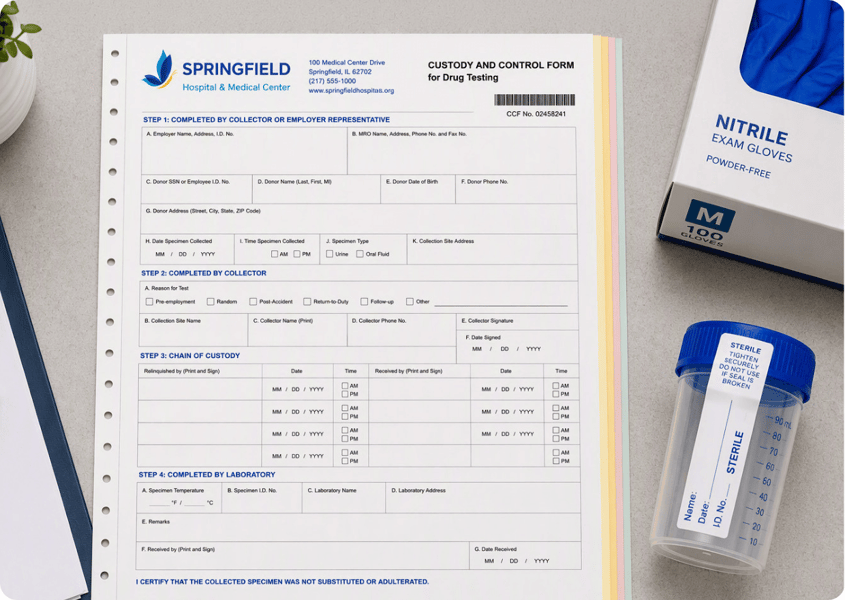
A Custody and Control Form (CCF) is the official federal document used to document specimen collection compliance and maintain chain-of-custody records throughout a DOT-regulated drug test. The form accompanies the specimen and serves as a critical link between the physical sample and the testing documentation.
The new five-ply CCF refers to an updated federally mandated version of the form consisting of five separate copies. Each copy serves a specific purpose within the testing workflow, ensuring appropriate documentation is retained by the parties involved in the testing process.
What are the upcoming DOT drug testing compliance changes and when do they take effect?
The DOT is implementing two significant documentation-related changes in the coming months. Although both changes relate to chain-of-custody procedures, they address different aspects of the testing process and require separate planning efforts. Organizations should view these changes as part of a broader modernization initiative designed to improve documentation accuracy, standardization and efficiency. Keep reading to learn what is happening regarding eCCFs and CCFs — and when these changes take effect.
Electronic Chain of Custody Form (eCCF)
The transition toward electronic chain-of-custody documentation continues to gain momentum across the industry. By August 2026, organizations that participate in DOT-regulated drug testing programs should ensure they understand applicable eCCF requirements and are prepared to support compliant digital workflows utilizing electronic drug testing forms.
The shift from paper-based documentation to electronic processes may affect laboratories, collection sites, third-party administrators and employers. Evaluating DOT-certified eCCF solutions well before implementation deadlines can help organizations avoid last-minute compliance challenges.
Custody and Control Form (CCF)
An additional compliance milestone arrives in May 2027 with the transition to a new federally mandated five-ply Federal Custody and Control Form. While many organizations remain focused on eCCF adoption, the CCF update should also be incorporated into long-term planning efforts.
Laboratories, collection sites and program administrators should review inventory management plans, supplier relationships and procedural documentation to support a smooth transition away from legacy forms.

How will Electronic Chain of Custody Forms (eCCFs) impact laboratories, collection sites and employers?
ECCFs represent more than a simple form replacement. For many organizations, such electronic drug testing forms introduce new workflows, updated responsibilities, and technology-driven processes that influence multiple stakeholders throughout the testing ecosystem. Successfully implementing eCCFs requires coordination among laboratories, collection sites, employers, software providers and program administrators.
Paper CCF vs. electronic CCF processes
Traditional paper-based workflows rely on physical forms that must be completed, transported, filed and stored throughout the testing process. These business forms management procedures often involve manual data entry and multiple handoffs that can introduce administrative inefficiencies.
Electronic workflows streamline many of these activities by enabling information to be captured and transmitted digitally. While the core chain-of-custody requirements remain unchanged, the compliance document management process itself becomes significantly different.
Preparing laboratories for the transition
Laboratories should begin by evaluating how eCCFs integrate with their existing laboratory information management systems, accessioning procedures and reporting workflows. Understanding current-state processes can help identify areas requiring new operational document solutions or additional technology support.
Organizations should also coordinate closely with collection sites and other stakeholders to ensure compatibility across the entire testing process. Successful implementation requires consistent secure forms management practices across all participating parties.
Compliance risks
The transition period itself may introduce compliance challenges if organizations continue relying on outdated processes or fail to adequately train personnel. Documentation errors, inconsistent procedures and incomplete implementation plans can increase administrative risk.
Maintaining compliant chain-of-custody documentation remains essential regardless of whether records are maintained electronically or on paper. Strong governance and clear procedures — based on proven secure document solutions — help reduce potential compliance issues.
Multi-site employers
Multi-site employers may experience both the greatest benefits and the greatest implementation challenges associated with eCCFs. Electronic drug testing forms and workflows can improve consistency across geographically dispersed locations while providing greater visibility into testing activities.
At the same time, organizations operating numerous collection sites must ensure that training, procedures and technology deployment are consistent throughout the enterprise. Early planning can significantly simplify implementation efforts.
What should organizations do now to prepare for the eCCF and new CCF transition?
The most effective preparation strategy begins with a comprehensive review of existing workflows. Organizations should document how specimens are currently collected, processed, tracked and reported so they can identify areas that may be affected by upcoming changes.
Next, laboratories and program administrators should evaluate eCCF readiness, review available DOT-certified eCCF solutions, and assess potential integration requirements. Organizations should also develop plans for transitioning to the new five-ply CCF, including inventory management, procedural updates and staff training.
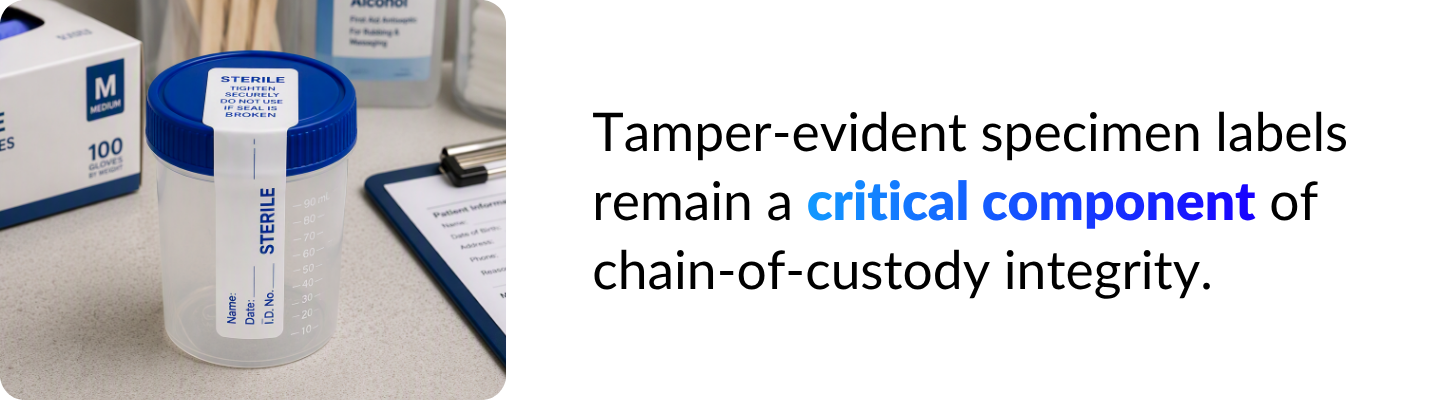
Finally, specimen labeling practices should not be overlooked. Tamper-evident specimen labels remain a critical component of chain-of-custody integrity, regardless of whether documentation is maintained electronically or on paper.
What are the trade-offs involved?
Like any significant operational change, the transition to eCCFs and the new CCF presents both opportunities and challenges. Consider the following trade-offs carefully before implementing changes to your DOT collection process workflow.
Efficiency gains vs. change management effort
Electronic documentation can reduce administrative burden, improve information accuracy and accelerate information sharing. However, achieving those benefits requires organizations to invest time in planning, training and implementation. The success of an eCCF initiative often depends as much on change management as it does on technology selection.
Long-term savings vs. upfront transition costs
Many organizations expect electronic workflows to reduce printing, storage and administrative costs over time. Improved laboratory operational efficiency may also create long-term productivity benefits.
At the same time, transitioning to new systems may require investments in software, integration services, training and process redesign. Organizations should evaluate both immediate and long-term financial implications when planning their strategy.
Early adoption vs. last-minute compliance risk
Organizations that begin preparing now typically have greater flexibility to evaluate options, test workflows and resolve issues before deadlines arrive. Early adoption can reduce implementation stress and provide additional time for stakeholder training.
Conversely, organizations that delay preparation may face compressed timelines, increased operational pressure and greater compliance risk as regulatory deadlines approach. For many laboratories and employers, proactive planning represents the most effective path forward.
Taylor: Compliant document management solutions for DOT collection processes
Testing laboratories and health systems nationwide depend on Taylor for their compliant forms and custom labels. Having supported large national laboratory organizations for decades, Taylor is uniquely positioned to provide implementation support related to the new federally mandated five-ply Federal Custody and Control Form (CCF) in May 2027. We also manufacture the tamper-evident labels and custom form-label combinations so vital to efficient drug testing laboratory operations.
Getting ready for the DOT drug testing compliance changes described in this blog? Contact Taylor — and our laboratory solutions team — to discuss our compliant forms, tamper-evident labels and transition planning capabilities.