Material Matters from Taylor - Q2 2026
Your quarterly update on the latest sourcing trends, market pricing and the overall state of supply chains.
Sourcing and Supply Chain Updates
Read on to get the latest news for the paper, label, packaging, promotional, logistics,
import markets (including tariffs), regulatory and compliance updates, and color management.
Table of Contents
Market Overview
Q2 2026 Market Trends and Economic Indicators
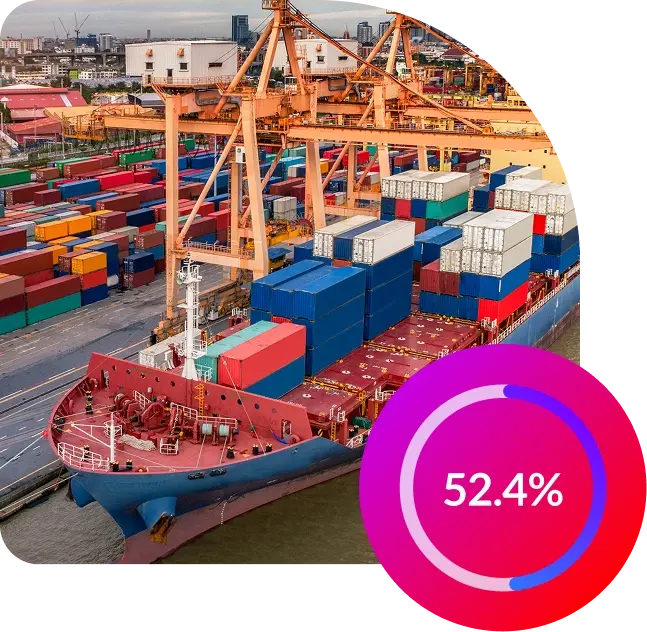
Institute of Supply Chain Management (ISM) manufacturing PMI index registered 52.4% in February 2026, marking the 16th straight month of expansion.
New orders, backlogs and production continued to grow, while raw materials and finished goods inventories contraction slowed. Prices surged to 11.5% (highest since June 2022). Overall the PMI Index continued to signal U.S. economic growth, primarily driven by AI investment, fiscal policy and tax incentives, easing monetary and tariff policy, resilient consumer spending, and manufacturing exports.
Consumer Spending/Sentiment
Consumer sentiment weakened significantly by late Q1 2026, reaching its lowest level since December 2025. Elevated fuel prices, inflation expectations and geopolitical risk from the Middle East conflict were primary drivers. Q2 2026 consumer spending is expected to remain soft with continued pressure on discretionary goods and services such as travel, dining and entertainment.
Commodity Pricing
Commodity pricing remains mixed with upward pressure across metals, chemicals, plastics, paper, packaging, electronics and energy inputs. Gasoline, diesel fuel and crude oil prices spiked sharply during end of Q1 2026 and into Q2 2026 largely due to the Middle East conflict. The U.S. tariff policy remains a consideration following the Supreme Court overturning the IEEPA specific tariffs. (See Imports section for more details.)
Energy
WTI crude oil, U.S. diesel, and gasoline prices have deviated sharply away from Q1 2026 projections, primarily driven by the Middle East conflict. Energy prices are expected to remain elevated through at least early Q2 2026. S&P Global and the OECD agree the current inflation spike is supply‑driven rather than demand‑led, reducing the risk of runaway inflation. However, price normalization is likely to take additional time during Q2 2026.
Inflation & Interest Rates
Paper Market Overview
Uncoated freesheet-UFS lead times are pushing out into June in some cases. These conditions seem to be driven by supply reductions (e.g., Chillicothe and Sylvamo) as well as operating downtime more than market demand.
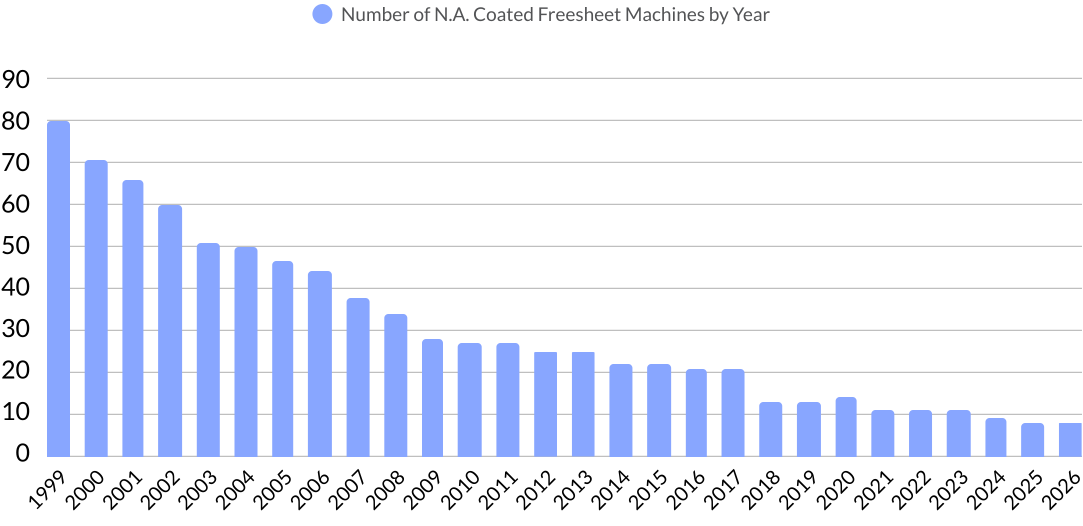
PPPC reports that UFS strength contrasts with steep coated declines in North America’s 2025 printing and writing paper markets.
Coated papers are a different story. The market is steady with manageable lead times, but there have been delays due to production challenges and pending scheduled downtime.
Paper Market Update
- Uncoated Free Sheet (UFS) – Sylvamo, Pixelle and Finch all remain on paper allocation. Sylvamo is expected to sell 55,000 tons less UFS in NA in 2026. Most of this reduction will occur in Q1. Sylvamo will also be revamping their paper machine (PM) at Eastover to start up in Q4. This this will cause their PM to be down for approximately six weeks.
- Pixelle is coming out of their outage which should loosen up availability from them. Domtar is the only NA UFS mill not on allocation. Operating rates are forecasted to stay in the low to mid 90's for the year. Inventory levels remain lean across the industry.
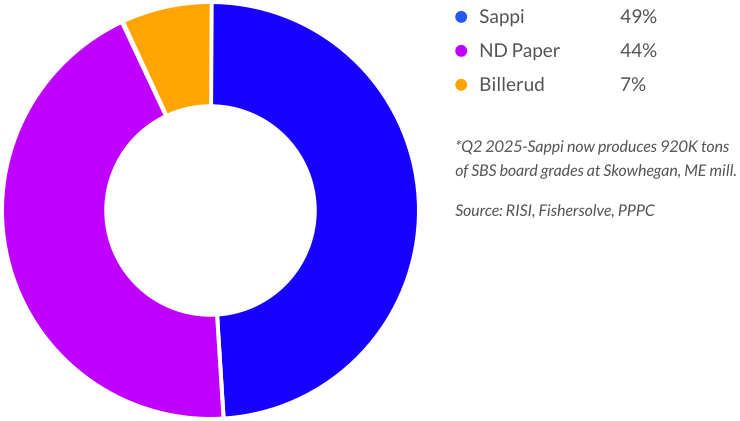
- Coated Free Sheet (CFS) – Sappi Cloque mill is on allocation. This reflects broader structural change in how supply is managed and distributed. Allocation appears to be used to balance the demand showing the system is less flexible than it has been in the past. Operating rates are forecasted to run in the low 80's.
- A key takeaway for both UFS and CFS is that the market has changed. Stability today depends on operations consistency rather than growth as it has in the past. Buyers should recognize that planning, communication and strong supplier relationships are key in this environment. Now is not the time to change suppliers or price shop.
Envelope Market Update
The industry continues to consolidate, and smaller players are struggling to maintain their market share as well as procure paper. Since January, Husky Envelope has closed their doors, adding themselves to the list of companies that have either been acquired, gone bankrupt or gone out of business. It's not known how the current conflict and perhaps poor economic outlook will impact the industry in the coming months, but it certainly won’t help.
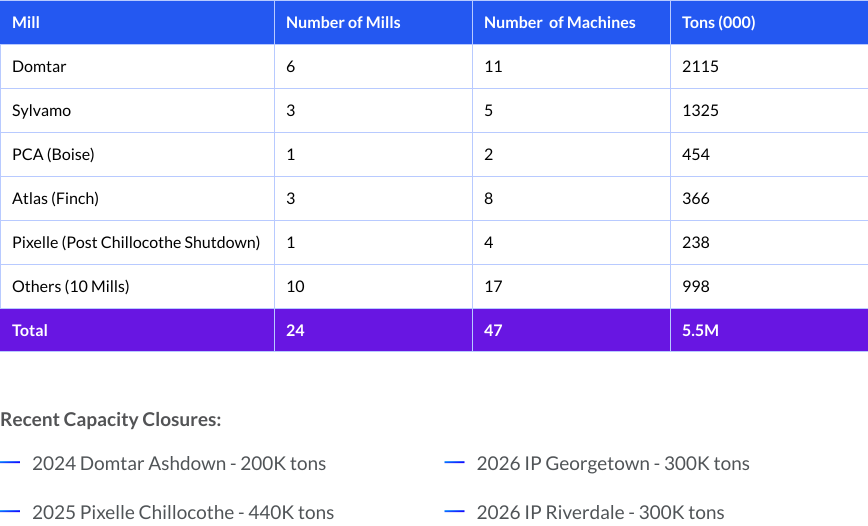
North American Uncoated Free Sheet Capacity
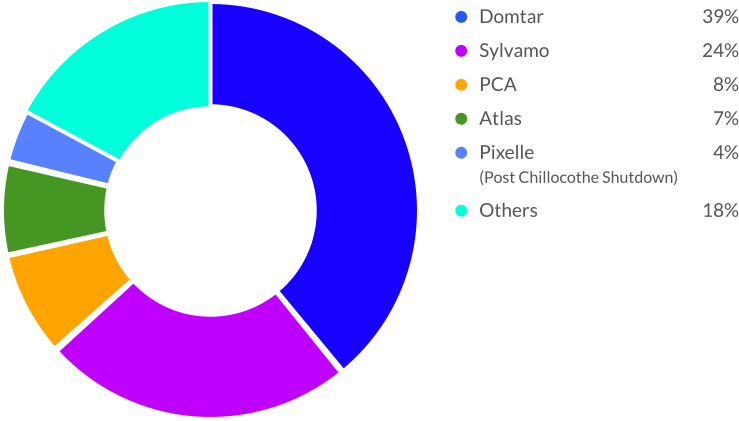
North American Uncoated Free Sheet Share
North American Coated Free Sheet Capacity
North American Coated Free Sheet Share
Label Market Overview
Paper Facestocks and Liners
- Thermal paper label facestock and paper liner materials supply is expected to be stable, but there is still pressure from the upstream paper mills.
- Pressures include mills continuing to move away from commodity paper products in favor of higher value products, further operations consolidation across NA and Europe, and/or additional paper mills being closed altogether.
- Global demand is expected to remain fairly stable with nominal growth.
- Platinum prices continued to climb to another all-time high of $2,800/ounce in mid Q1 2026. Pricing in Q2 2026 is expected to remain fairly stable, remaining closer to $2,000/ounce. These increases in platinum pricing are forcing increases in silicones used for label liner manufacturing costs.

Films and Adhesives
- BOPP and PET film prices have risen notably, driven by Middle East geopolitical tensions and upward adjustments in the propylene resin CDI index. These increases are expected to intensify cost pressure across prime and durable label segments, including retail, HBA, industrial and general-purpose consumer products.
- Acrylic and hot-melt adhesives demand remains strong with a stable supply into Q2 2026. Raw material input costs for adhesives continue to increase due to global petroleum price volatility.
- Even with these pressures, overall BOPP, PET and other filmic raw material supply remains sufficient to meet both North American and global demand.
Labels PPI
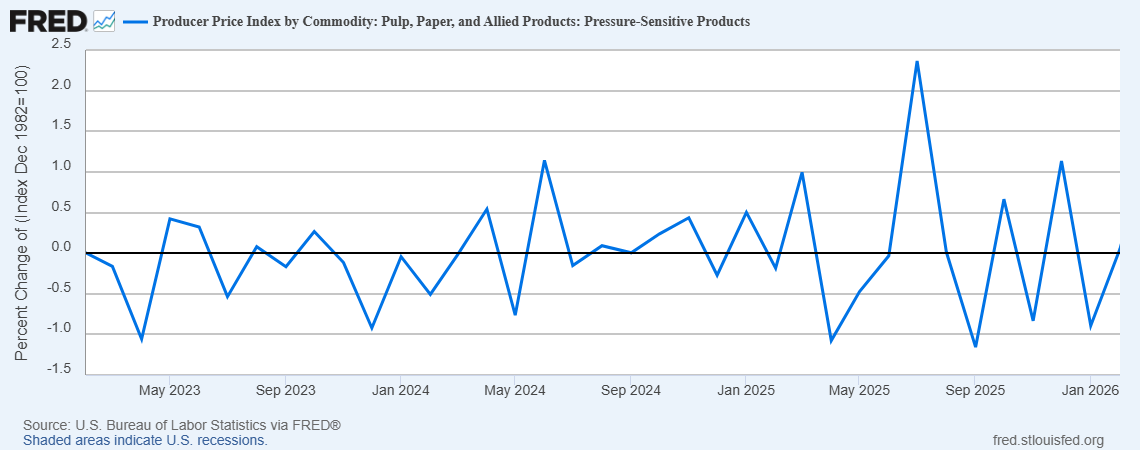
The graph below details the Producer Price Index (PPI) for raw label pressure-sensitive materials from February 2023 through February 2026.
NOTE: New quarterly data not available until mid-to-late April 2026.
Packaging Market Overview
The packaging market remains unstable, driven by tariffs, industry
consolidation and the conflict in the Middle East.
Aluminum & Tooling/Die Categories
- Aluminum material pricing increased in February 2026 with tariffs continuing to pressure the market. Aluminum costs are having the greatest impact on CTP equipment.
- Processless plates continue to be a rising trend in the overall plate-making market.
- Demand for aluminum plates is growing moderately and is expected to continue into 2027.
- Tooling and die markets have implemented price increases and tariff surcharges driven by higher material costs and trade policy changes.

Corrugated & General Packaging Supplies Update
- Market price increase of $40/ton market went into effect in Q1 2026.
- Increasing fuel costs are creating instability in the corrugated packaging market.
Wood Pricing
- Key suppliers have implemented price increases as a result of continued tariffs and increased energy costs.
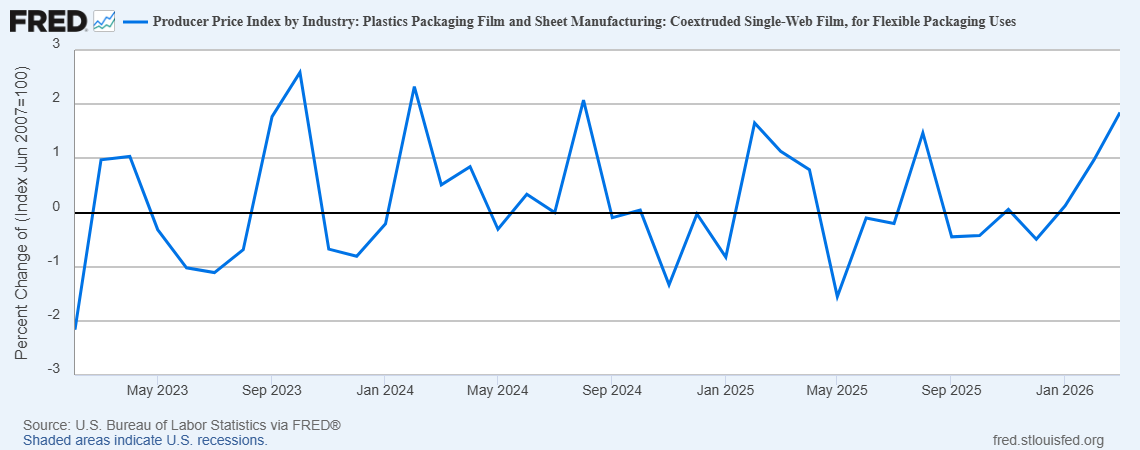
PPI: Flexible Packaging Film
The graph below details the Producer Price Index (PPI) pricing for flexible packaging film from February 2023 through February 2026.
NOTE: New quarterly data not available until mid-to-late April 2026.
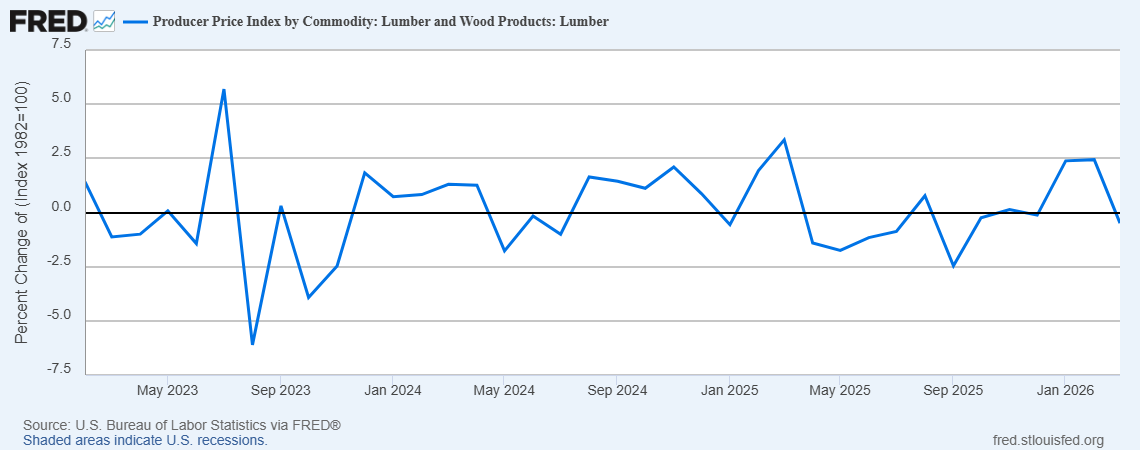
PPI: Lumber and Wood Products
The graph below details the Producer Price Index (PPI) pricing for lumber and wood products from September 2023 through September 2025.
NOTE: New quarterly data not available until mid-to-late April 2026.
Promotional Market Overview
As Q2 2026 begins, we take a look at the latest promotional sector trends and
impacts on the global market that are expected for the remainder of 2026.
The Key Forces Shaping 2026
Energy Driven Cost Pressure
- Conflict in the Middle East is driving sustained fuel price volatility.
- Freight, LTL and last-mile delivery costs continue to rise.
- Petroleum-based promotional materials face structural cost pressure.
Supplier Pricing & Execution Response
- Suppliers are absorbing cost increases in the near-term to protect relationships.
- Inventory drawdowns are being paired with targeted, selective price actions .
- Margin discipline and execution are being prioritized over volume-driven growth.
Made-in-USA & America250 Momentum
- The U.S. 250th anniversary is accelerating demand for patriotic programs.
- Suppliers are expanding Made‑in‑USA assortments and domestic capacity.
- U.S. sourcing is positioned as a strategic risk‑reduction lever.
Sources:
ASI Counselor – Rising Fuel Prices Poised to Drive Up Costs for Suppliers
ASI Counselor – Everything You Need to Know About America250
Logistics Market Overview
The overall logistics industry Q2 2026 market will be defined by rising cost pressure without a full demand recovery. Capacity is expected to tighten, especially in North American trucking.
Fuel volatility, geopolitical disruption in the Middle East, and regulatory and tariff uncertainty are all pushing freight rates higher even as shipping volumes remain uneven.
Logistics providers broadly agree the market has entered a "structural transition phase," shifting from a shipper‑favored environment towards a more logistics provider-favored environment by late 2026.
Small Package Outlook: Carrier Market Strategies
-
USPS
Major structural shifts are underway with continued GRI's (8% fuel surcharge from April 2026 through January 2027). This additional GRI follows the current rate increase of 7%-8% on Ground Advantage and Priority Mail services. Even with these rate increases, USPS still remains competitive for 1lb or less mail service. -
FedEx
A strong Q2 FY26 performance is expected, driven by pricing discipline, yield improvement and Network 2.0 cost management initiatives. FedEx is keeping a firm stance on 2026 GRI's while tightening discount structures and being more strict with accessorial execution. The pending FedEx Freight spin-off (June 2026) may allow FedEx Express to continue to focus more on parcel service profitability. -
UPS
UPS is continuing their "Better, Not Bigger" approach to offer shippers optimal package service programs. They are pursuing multi-year agreements and increasing scrutiny of larger packages, irregular handling and rural deliveries. -
Amazon.com Services
Amazon implemented a 3.5% fuel and logistics surcharge for third-party sellers using Fulfillment by Amazon (FBA). Amazon.com Services' NA service network continues to grow, putting more pressure on traditional small package providers such as UPS, FedEx and DHL.
Less-Than-Truckload Logistics Market Overview
The North American LTL freight environment in Q2 2026 is expected to be soft on demand, but carriers are firmly controlling market pricing as compared to a year ago.
Carriers are prioritizing yield, efficiency and network readiness over short‑term volume gains. Despite ongoing freight softness, carriers are not competing aggressively on price, which is signaling structural discipline.
Capacity & Demand
-
LTL carriers continue to invest in terminal expansion, fleets and equipment, signaling long‑term confidence in the market despite current conditions.
-
Investments are highly targeted toward network resilience and efficiency, not rapid capacity expansion.
Carrier Pricing Strategies
-
Pricing discipline remains strong even with soft demand.
-
Carriers are holding firm on rate increases, preferring margin protection over shipment growth.
-
This behavior reflects higher operating costs and tighter network control, not demand‑side pressure.
-
LTL pricing is increasingly disconnected from near‑term volume trends.
Outlook
-
Pricing will remain firm through Q2 2026 even if demand stays flat.
-
Capacity will be available but selective, favoring well‑profiled freight.
-
Shippers should not expect rate relief without meaningful overall market demand deterioration.
-
The LTL logistics market is positioned for a controlled recovery, not a rebound driven by competition.
Truckload Logistics Market Overview
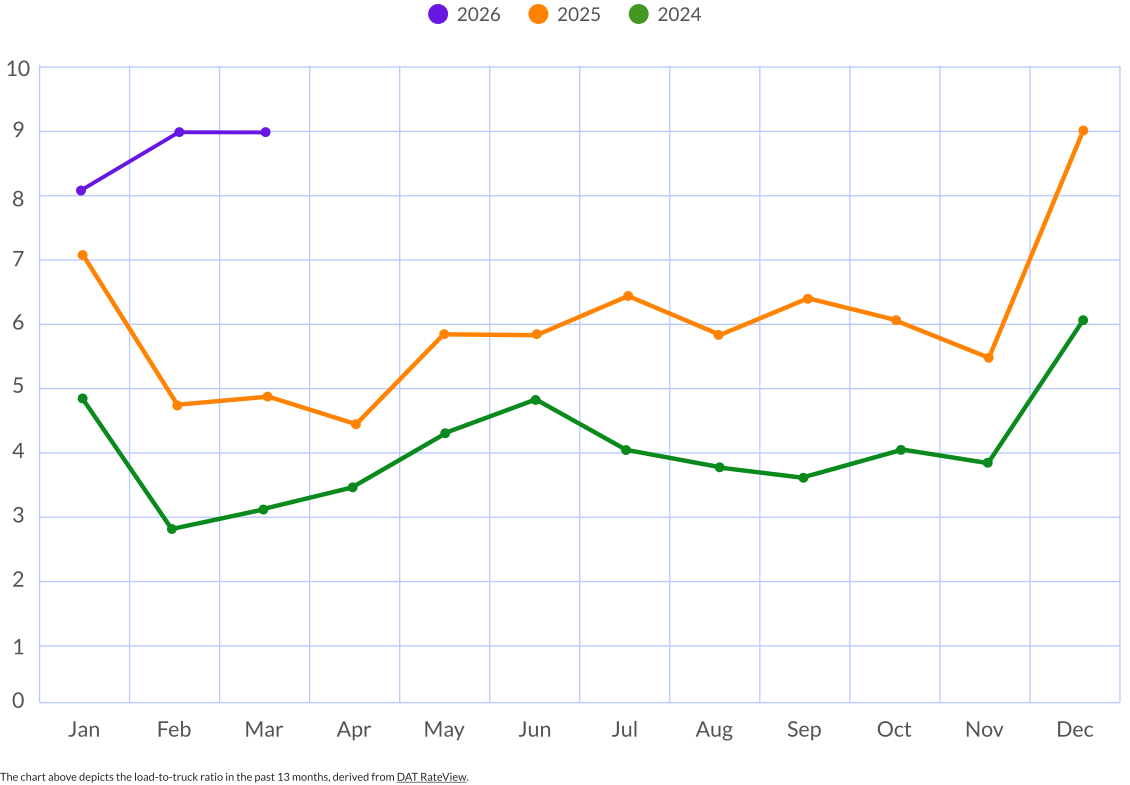
The North American truckload market has reached a critical inflection point, transitioning from prolonged deflation into a period of sustained spot and contract rate inflation throughout 2026. Several years of weak carrier economics have driven a significant capacity exit, leaving the market far more sensitive to disruptions despite demand remaining relatively soft.
While demand growth is expected to be modest in Q2 2026, capacity constraints, not demand surges, are now the primary driver of truckload freight rate increases. Seasonal events, weather disruptions and regulatory pressures are expected to amplify volatility, especially during the summer peak shipping season.
Capacity & Demand
- The truckload market is now balanced, meaning any disruption has an outsized impact on rates.
- Winter storms served as a catalyst but were not the root cause.
- Rate inflation could persist even without meaningful demand growth.
Carrier Pricing Strategies
- Elevated spot rates are disrupting routing guides.
- Carriers are gaining contract pricing leverage as operating costs rise.
- Contract rates will lag spot rates but continue increasing through the end of the year.
- Contract LTL rates are up 10% YOY and spot TL rates are up 24% YOY.
Outlook
- Produce season, DOT Roadcheck (mid-May) and the summer peak are critical points to watch.
- Spot rates are expected to hit multi-year highs during summer 2026.
- Upside risks could push inflationary conditions into 2027.
Van Demand & Capacity
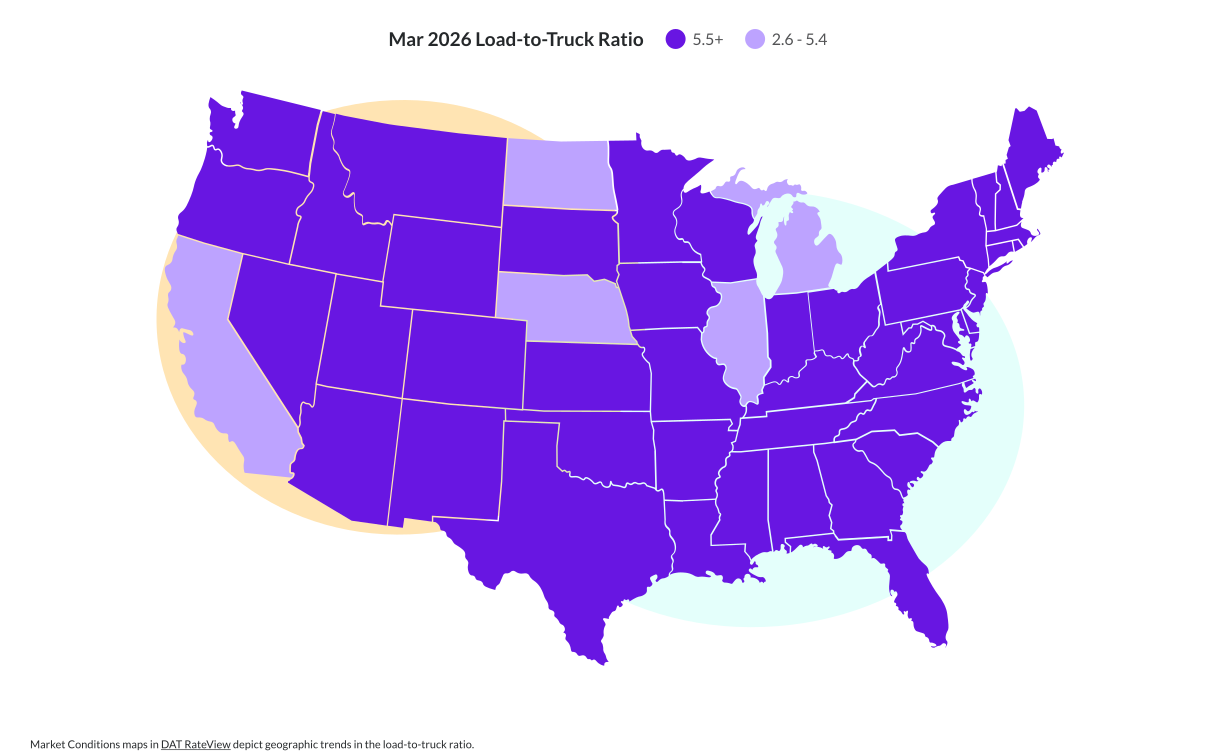
Van Load-to-Truck Ratio
International Logistics Market Overview
The international logistics conditions in Q2 2026 are defined by resilient demand, elevated geopolitical risk, volatile fuel costs and structurally higher complexity rather than congestion.
While capacity across ocean and air logistics providers is generally sufficient, route disruption, contracting caution and regulatory uncertainty are preventing a full normalization of rates and service reliability.
The conflict in the Middle East will certainly be a major factor in East-to-West international logistics, forcing significant rate increases, higher risk insurance values and longer lead-times from Asia to the U.S.
Ocean Freight
-
There is excess nominal capacity, but effective capacity remains constrained due to continued Red Sea/Middle East diversions via the Cape of Good Hope in Africa.
-
There are elevated bunker fuel costs and war-risk insurance surcharges.
-
Blank sailings and ongoing carrier network adjustments continue.
-
Iran is demanding significant monetary fees to allow safe passage of commercial cargo ships through the Strait of Hormuz.
Air Freight
- Strong YOY growth in air cargo volumes (10–11%) has been led by Asia‑Pacific export lanes, ecommerce, and high‑value and urgent goods, and supply‑chain diversification away from single‑country sourcing.
- Capacity growth trails demand, supporting yield recovery and tighter load factors.
- Air freight remains a premium mode of logistics, primarily due to the no‑fly zones over parts of the Middle East, elevated fuel costs passed onto the customer and limited widebody aircraft availability on disrupted lanes.
Outlook
-
Trade policy volatility remains the primary wildcard in Q2 2026.
-
Refund processing of certain IEEPA‑related tariffs continue, but timelines remain uncertain.
-
Temporary or alternative tariffs are being introduced in parallel, complicating landed‑cost forecasts.
-
Shippers are delaying long‑term sourcing commitments, favoring multi‑country and multi‑mode optionality.
U.S. Postal Service Market Updates
Q2 2026 is expected to be a pivotal period for the U.S. Postal Service. The organization enters the quarter facing
continued financial pressure ($1.3B net loss in Q1 2026), material shipping price increases effective
April 26, 2026, and ongoing execution of its Delivering for America (DFA) transformation.
USPS remains strategically focused on package revenue growth, Ground Advantage expansion and
network modernization, while mail volumes continue structural decline. These dynamics create both cost
pressure and service variability for commercial shippers.
New USPS Pricing Changes
- Effective January 18, 2026
- USPS Ground Advantage
7.8% increase - Priority Mail Service
6.6% increase - Parcel Select Service
6.0% increase - Priority Mail Express Service
5.1% increase - First-Class Mail Stamps
Pricing remains unchanged at its current 78-cent rate
USPS Rate Increase Proposal
- USPS filed a proposal seeking greater flexibility to raise prices beyond CPI‑based limits to compensate for financial
losses and falling mail volumes. - The proposal does not address service or performance improvements.
Time-Limited, Transportation-Related Rates
- Effective April 26,2026, through January 17,2027.
- *Rates in addition to already existing 2026 rate changes.*
- USPS Ground Advantage
8.0% increase - Priority Mail service
8.0% increase - Parcel Select
8.0% increase - Priority Mail Express service
8.0% increase
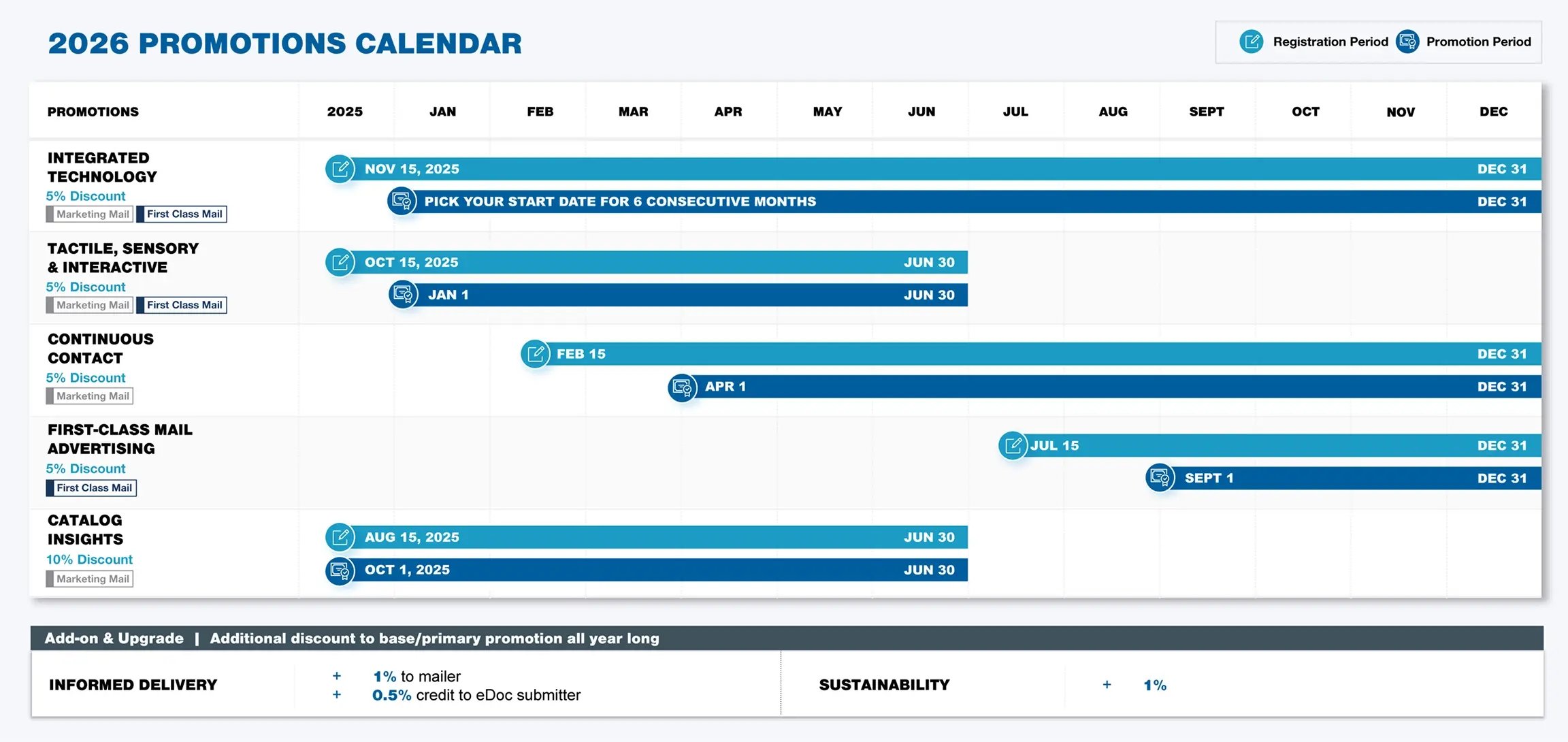
Reminder: New 2026 Promotions

- Registration for catalog insights was effective as of Aug. 15, 2025. Tactile, sensory and interactive promotion registration started Oct. 15, 2025.
- All the New 2026 Promotions: 2026 Promotions Guidebooks | PostalPro
International (Imports) Market Overview
The Supreme Court decision on the illegality of IEEPA tariffs has set off a series of actions for importers seeking refunds from the government for paid tariffs.
Global tariff policy is changing frequently. Updates will be presented by the Taylor Sourcing Team as necessary.
State of IEEPA Tariff Refunds
What did the Supreme Court decide about IEEPA tariffs?
The Supreme Court held that the International Emergency Economic Powers Act (IEEPA) does not authorize the
President to impose tariffs. The majority focused on statutory text, noting Congress did not expressly grant tariff-imposition authority under the IEEPA.
Where do refund issues stand now?
The Supreme Court did not set a refund process. Refund questions were remanded to the Court of International Trade (CIT). The CIT ordered Customs and Border Protection (CBP) to develop a process and is receiving weekly updates.
CBP has proposed using a combined administrative process (the CAPE
process) and is building the mechanics to implement refunds.
Who may be eligible for refunds?
All importers of record are eligible for refunds. 330,566 importers paid IEEPA tariffs across about 53 million entries, totaling approximately $166 billion.
CBP has signaled that importers may need to file claims and that those in litigation could be treated differently.
What about liquidated entries?
The CIT has said unliquidated or not-finally-liquidated entries should move through the process.
Liquidated entries present added procedural hurdles.
IEEPA Tariff Refund Readiness & Expectations
Tariff Refund Readiness
Importers should immediately enroll in ACE and set up ACH to receive refunds, track liquidation dates, and run CBP reports to access potential tariff refunds for both liquidated and unliquidated entries.
If you have not received this report on your specific tariff refund numbers, please contact Taylor Strategic Sourcing.
Expect Different Tariffs in the Future
Expect tariffs to replace Section 122 tariffs expiring in July, via Sections 232 and new 301 actions (including forced labor and excess capacity), alongside sustained legal challenges. Watch 301 and 232 investigations, and USMCA’s review for policy shifts.
- Section 301 of the Trade Act of 1974, which addresses unfair trade practices by other countries.
- Section 232 of the Trade Expansion Act of 1962, which responds to imports that may be a threat to U.S. national security
Electronic Refunds
Beginning February 6, 2026, U.S. Customs and Border Protection (CBP) will issue all refunds electronically via Automated Clearing House (ACH) (subject to limited exceptions).
Compliance/Regulatory
Market Overview
Taylor’s corporate Procurement Compliance Team continues to develop and implement strategic adjustments, which are outlined in the following section.
The enhancements are designed to ensure a responsible framework in the Taylor Procurement Compliance Program.
Taylor Compliance - Program Enhancements
Documented Product Safety Risk Assessments
Proactively managed Product safety risks across the entire product lifecycle, not solely at the manufacturing stage.
Evidence-Based Chemical Safety Determinations
Market Surveillance & Corrective Action Governance
PFAS in Consumer Products
Per- and polyfluoroalkyl substances ("PFAS") consists of approximately 15,000 synthetic chemicals also known as "forever chemicals" due to their long-lasting life cycle. They are commonly found in non-stick cookware, waterproof clothing, and fast food wrappers and take-out containers such as pizza boxes. Several states in the United States have enacted laws or proposed bills that restrict, limit or require warnings when a specific consumer good contains PFAS.
| State | Enacted Law | State | Enacted Law | State | Enacted Law |
|---|---|---|---|---|---|
| California | Prop 65 | Maine | 06-096 Ch. 890 | New York | S 501B |
| Colorado | HB22-1345 | Maryland | HB643 | Oregon | 431A.250 |
| Connecticut | #21-191 | Minnesota | Minn. Stat. §325F.075 | Rhode Island | S724, H7538, H7619 |
| Hawaii | HB 1644 | New Hampshire | HB 1649 | Vermont | 18VSA §1773 |
| Illinois | HB 2516 | New Mexico | HB 212 | Washington | RCW 70A.222.070 |
California SB 343 – Truth in Labeling for Recyclable Materials
The State of California has enacted a new labeling law that prohibits use of the chasing arrows or any other indicator of recyclability on products and packaging unless certain criteria are met. Products and packaging displaying a chasing arrows symbol must:
- Meeting specific statewide recyclability criteria.
- Be handled through a defined-stream recycling process by large-volume transfer or processing facilities that serve 60% of the recycling programs statewide with defined streams sent to and reclaimed at a reclaiming facility.
- May not include nonrecyclable components, inks, adhesives or labels that prevent recycling.
- May not contain certain intentionally added chemicals.
- Meet other requirements.
For more information go to https://calrecycle.ca.gov/wcs/recyclinglabels/.