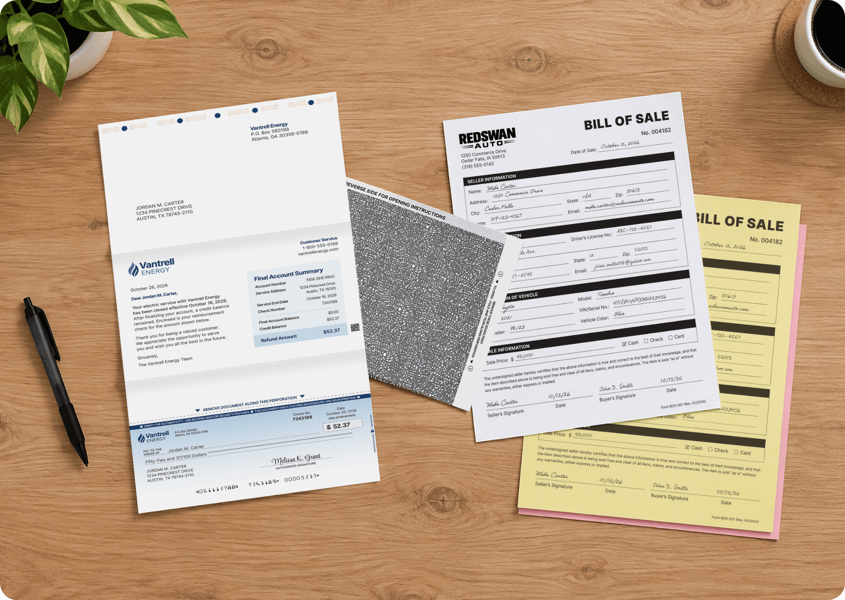
Some of the most important business communications still rely on printed products. Tax documents, permits, account statements, certificates, inspection records and compliance documentation may contain sensitive information — or serve as evidence that a required transaction occurred. That makes reliable production and controlled handling essential.
But security means different things in different workflows. For a document traveling through the mail, the first concern may be protecting confidential information from view and reducing opportunities for mismatching documents and recipients. For a form moving among employees, departments or outside organizations, establishing an identifiable record of each transaction may be more important.
Modern secure print solutions address those requirements in different ways. Understanding the roles of pressure-seal technology, carbonless construction, sequential numbering, variable data printing and other security features can help purchasing teams choose a secure forms printing service — and a format that balances security, traceability and production efficiency.
Keep reading below for an overview of secure document printing and explore the benefits of pressure-seal forms as compared to carbonless security forms.
- What is secure forms printing?
- What makes a printed form secure?
- What are serialized forms?
- How do serialized forms improve security and document traceability?
- What are pressure-seal forms and are they the same thing as pressure-seal mailers?
- How do pressure-seal forms protect confidential information?
- Are pressure-seal forms secure?
- What are pressure-seal forms used for, and when are they the best choice for sensitive documents?
- What are carbonless forms?
- Are pressure-seal forms more secure than carbonless forms?
- How do you choose between pressure-seal and carbonless forms for sensitive documents?
- Permit applications
- Business licenses
- Tax forms
- Tax notices
- Utility bills
- Account statements
- Benefits enrollment forms
- Inspection reports
- Compliance reports
- Trade-offs: What are the best secure forms printing options for sensitive documents?
-
- Pressure-seal mailers vs. traditional envelope mailings
- Pressure-seal mailers vs. serialized carbonless forms
- Pressure-seal forms vs. self-mailing documents
What is secure forms printing?
Secure forms printing is the production of business forms using materials, processes or features designed to help protect sensitive information, control documents, or support verification and traceability. Depending on the application, security can involve protecting information during mailing, identifying individual forms, documenting transactions, or making unauthorized access or alteration easier to detect.
As a result, secure forms printing services can include technologies ranging from serialization and barcoding to pressure-seal construction, security papers, and other overt or covert features. The right combination depends on what needs protection, how the form will be used, and what kind of record the organization needs to maintain.
What makes a printed form secure?
There is no single feature that makes a printed form secure for every application. Effective secure business forms match specific safeguards to the risks associated with the document, including unauthorized viewing, substitution, duplication, loss or an inability to account for individual forms.
For example, tamper-evident forms can make physical interference more apparent, while serialization helps distinguish and track individual documents. Other applications may use security backgrounds, watermarks, microprinting, barcodes or controlled document-production workflows. Security therefore comes from the complete system surrounding the form, not simply the paper itself.
What are serialized forms?
Serialized forms carry a unique identifier, typically created through sequential numbering or another variable identification system. Instead of producing thousands of otherwise indistinguishable forms, serialized forms printing can assign a different number to each form or form set.
This makes sequentially numbered forms valuable when accountability is important. Depending on the workflow, identifiers can be associated with transactions, recipients, locations, batches or other records, creating a practical connection between the physical form and an organization's document management processes.
How do serialized forms improve security and document traceability?
Serialization gives organizations a way to identify individual documents throughout a workflow. With numbered forms printing, a unique number can help users determine which forms were issued, processed, retained, voided or otherwise accounted for.
This capability is especially valuable for document tracking forms, permits, certificates and other items for which accountability matters. For applications that involve transfers between people or locations, serialization can also support chain-of-custody forms by giving the form, specimen or transaction a consistent identifier. Some chain-of-custody applications combine multiple carbonless copies with specimen identification numbers, barcodes and labels so information can follow an item through multiple stages.
What are pressure-seal forms and are they the same thing as pressure-seal mailers?
Pressure-seal forms are specially constructed documents with cohesive material that bonds when the document is folded and mechanical pressure is applied. Once processed through appropriate folding and sealing equipment, the form itself becomes the mailpiece, eliminating the need for a separate envelope.
The terms overlap, but they emphasize different aspects of the product. Pressure-seal forms printing describes production of the forms, while pressure-seal mailers printing emphasizes their use as finished pressure-seal mailers. When forms are folded, sealed, addressed and mailed without an envelope, they function as self-mailers or self-mailing forms.
How do pressure-seal forms protect confidential information?
Pressure-seal construction keeps the printed content inside the folded document during mailing. The cohesive areas bond under pressure and the recipient opens the piece along its designated edges or perforations, providing a format designed to protect information from casual view during distribution.
The format can also reduce handling steps. Because the document and mailpiece are one piece, automated workflows can eliminate the separate envelope inserting operation. Industry providers also note that printing document content and recipient information on the same piece can reduce the possibility of inserting the wrong document into an envelope.
These characteristics make pressure-seal technology particularly attractive for confidential document mailers containing personalized information.
Are pressure-seal forms secure?
Yes, pressure-seal forms can provide meaningful physical security for mailed communications. Properly produced pressure-seal documents use cohesive material and pressure to create a sealed mailpiece, with some products designed to produce a visible fiber tear when opened and therefore provide tamper evidence.
However, pressure sealing should not be confused with comprehensive document security. Depending on the risk, tamper-evident documents may also require controlled data processing, authentication features, serialization or other safeguards. The required level of protection should drive the specification.
What are pressure-seal forms used for, and when are they the best choice for sensitive documents?
For buyers asking “what are pressure-seal forms used for,” one of the clearest answers is high-volume transactional and confidential mail. Common applications include tax documents, utility bills, statements, invoices, notices, benefit summaries and other communications containing recipient-specific information.
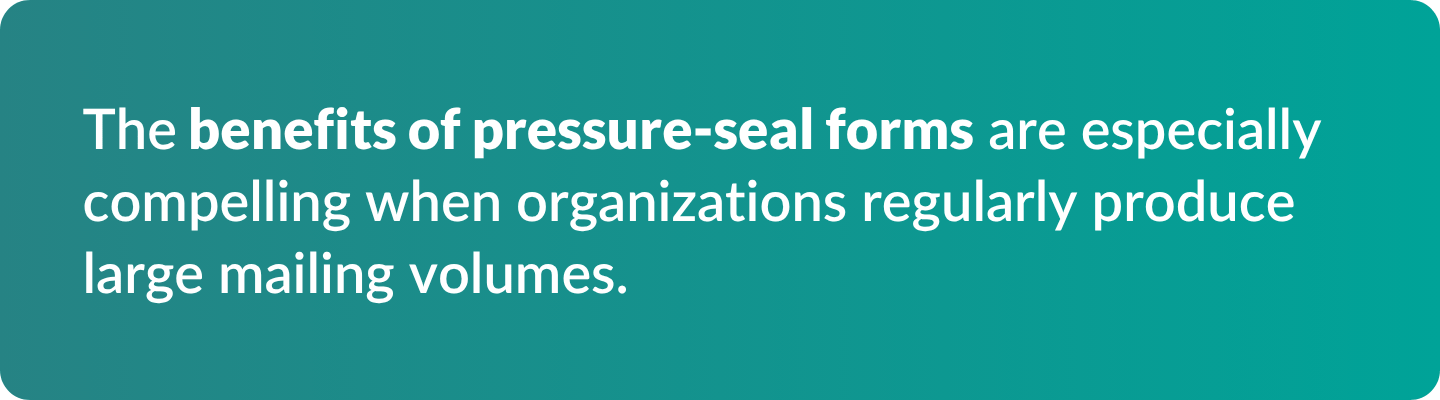
The benefits of pressure-seal forms are especially compelling when organizations regularly produce large mailing volumes. Combining the document and mailer can eliminate envelopes, reduce material requirements and consolidate folding, inserting and sealing into a more streamlined workflow.
Pressure-seal is therefore a strong option for secure document printing when confidentiality and efficient outbound mailing are the primary requirements. Organizations considering secure pressure-seal forms should evaluate their document format, print volumes, finishing equipment, postal requirements and required security features together.
What are carbonless forms?
Carbonless forms produce copies of information entered on a top sheet without requiring traditional carbon paper between the sheets. Often called NCR forms, they can be produced as two-part, three-part or other configurations that provide copies for different people, departments or business records.
That makes multi-part forms particularly useful when one transaction must create several corresponding physical records. Carbonless security forms can also incorporate unique numbering and other security features when additional control is required. Commercial carbonless forms are commonly available with sequential numbering for tracking and in two-part or three-part sets.
Are pressure-seal forms more secure than carbonless forms?
Pressure-seal forms are not inherently more secure than carbonless forms. Comparing pressure-seal forms vs. carbonless forms solely on which is "more secure" overlooks the fact that the two formats address different needs.
Pressure-seal technology is generally stronger when confidential information must become a sealed, tamper-evident mail piece without a separate envelope. Serialized secure carbonless forms, by contrast, can be better suited to transactions requiring multiple copies, signatures, distribution among multiple parties, or a physical audit trail.
The deciding question is therefore not simply which format offers greater security. It is what kind of security the process requires: confidentiality during delivery, traceability throughout a transaction, or a combination of both.
How do you choose between pressure-seal and carbonless forms for sensitive documents?
Start with the document's workflow. If information is generated electronically and mailed directly to an individual, pressure-seal technology can provide an efficient path from printing to a sealed mailpiece. If information is captured during a transaction and several parties need corresponding copies, serialized carbonless construction may be more practical. Review the following real-world applications to see how those priorities can change.
Permit applications
Permit workflows often require information to move between applicants, reviewers and government offices. When multiple physical copies or accountable document numbers are required, serialized carbonless construction can support tracking and record retention.
If the primary requirement is mailing a confidential permit-related notice to an applicant, pressure-seal may be more appropriate. The workflow determines the format.
Business licenses
Business license processes can involve applications, approvals, renewals and certificates. Serialized forms can help distinguish individual documents when unique numbers are important to administrative control.
Pressure-seal formats can play a different role by delivering confidential notices, renewal information or other personalized communications. A single program may therefore use both technologies at different stages.
Tax forms
Tax documents are a classic pressure-seal application because they combine sensitive personal or financial information with recurring mailing requirements. Pressure-seal W-2 and 1099 products are commercially available specifically for this type of distribution.
For organizations processing significant mailing volumes, pressure-seal mailers can reduce the number of separate materials and finishing steps involved. The document becomes its own sealed mailing piece rather than being matched with an envelope.
Tax notices
Tax notices often contain recipient-specific information that should not be visible during normal mail handling. Pressure-seal formats can protect the printed information inside a sealed document while supporting automated production.
Where tax-related transactions require accountable copies for multiple parties, serialized carbonless construction may still have a role. The critical distinction is outbound confidential communication versus transaction documentation.
Utility bills
Utility bills and similar statements are well suited to pressure-seal processing because they are typically personalized and mailed at scale. Pressure-seal is an established application for utility bills, invoices and statements.
Using a single piece as both document and mailer can streamline production. Variable data printing can place customer-specific information and addressing on each form before folding and sealing.
Account statements
Account statements often contain confidential financial or transactional information, making privacy during delivery an important consideration. Pressure-seal systems provide a way to conceal statement content while creating an efficient self-mailing format.
Where statements require additional authentication or security, other features can be incorporated into the overall specification. Buyers should distinguish between privacy during transit and controls intended to prevent reproduction, alteration or fraud.
Benefits enrollment forms
Benefits communications can contain sensitive employee-specific information and may involve both outbound communications and information returned by employees. Pressure-seal formats can be useful for personalized benefit statements, notices and summaries sent through the mail. Benefits summaries are among the applications offered for pressure-seal systems.
When an enrollment transaction requires multiple physical copies, signatures or records distributed among different parties, carbonless construction may offer a better workflow. Here again, the information flow should determine which format is selected.
Inspection reports
Inspection work often creates documentation at the point where an inspection occurs. Multi-part forms can allow an inspector to complete one form while immediately producing copies for the inspector, facility or administrative office.
Adding serialization provides another layer of accountability when each inspection report needs an individual identifier. This can be particularly useful when paper records must later be reconciled with a database or other tracking system.
Compliance reports
Compliance documentation can require clear records of what was completed, by whom and under what transaction or reference number. Serialized carbonless formats support situations where multiple parties need matching records of the same event.
The exact specification depends on the governing program. For regulated applications, compliance forms printing should be designed around the applicable recordkeeping, security and document-control requirements rather than assuming one construction satisfies every compliance need.
Trade-offs: What are the best secure forms printing options for sensitive documents?
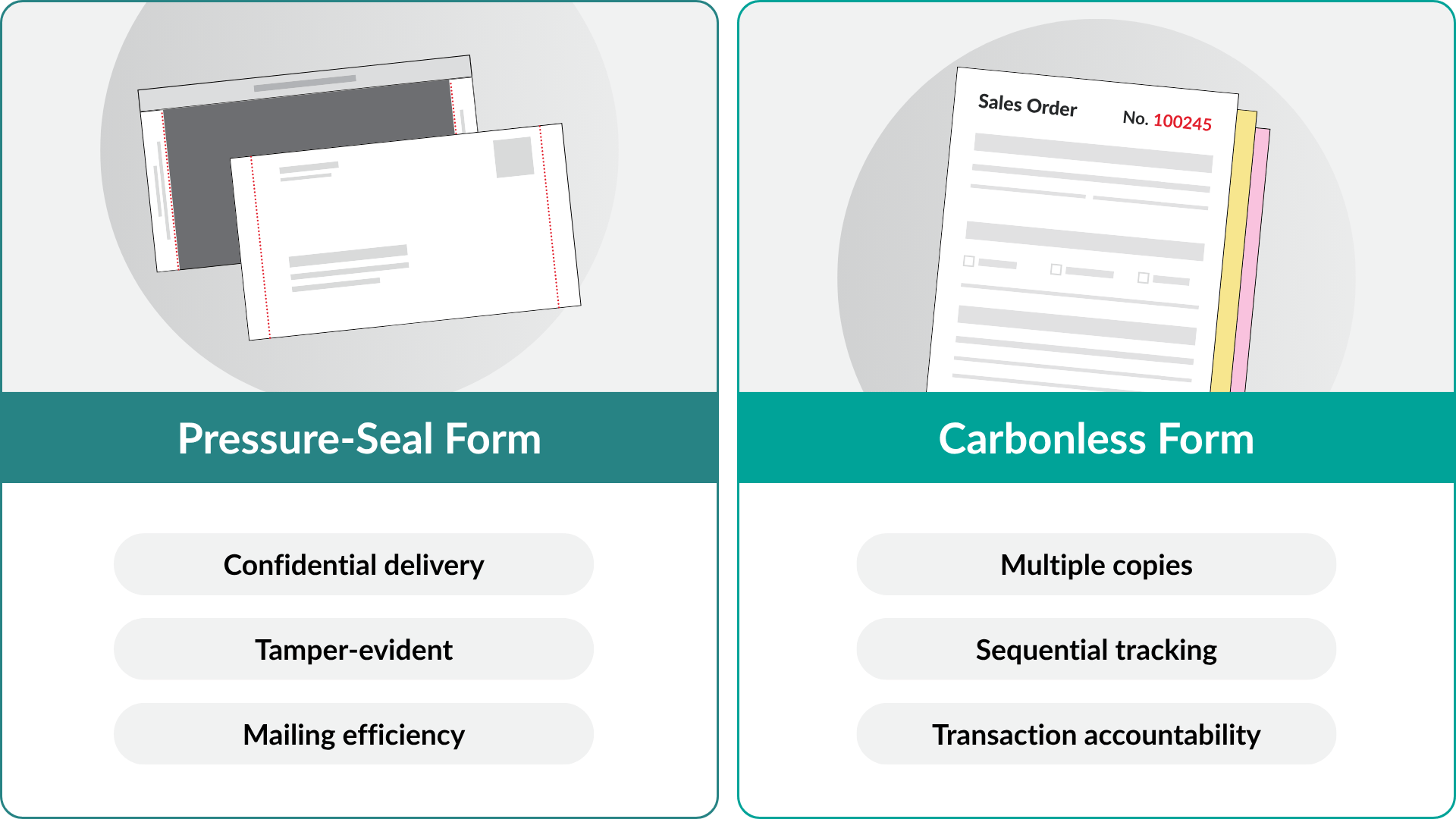
Finding the best secure forms printing options for sensitive documents starts by defining the security objective. Pressure-seal technology emphasizes confidential distribution and mailing efficiency, while serialized carbonless forms emphasize duplicate records, accountability and transaction traceability.
Neither format has to work alone. Serialization, barcodes, variable data printing, and other security features can complement the underlying form construction to create a solution aligned with the organization's workflow. Be sure to consider these primary trade-offs when selecting a secure print solution for your organization.
Pressure-seal mailers vs. traditional envelope mailings
Traditional envelope workflows require separate documents and envelopes, followed by folding, inserting and sealing. Pressure-seal processing combines the form and mailing container, eliminating the envelope and the separate stuffing step.
That can provide meaningful operational advantages for high-volume transactional mail. Traditional envelopes can still be preferable when communications include multiple inserts, unusual document configurations, or other materials that cannot be incorporated into a single pressure-seal piece.
Pressure-seal mailers vs. serialized carbonless forms
Choose pressure-seal when the central challenge is securely delivering confidential information to a recipient. Choose serialized carbonless construction when the central challenge is producing multiple corresponding records and maintaining traceability through a transaction.
For example, a mailed tax statement points naturally toward pressure-seal, while a multi-copy inspection record or chain-of-custody form may favor carbonless construction and serialization. In some workflows, both approaches can coexist, with carbonless documents capturing a transaction and pressure-seal mailers subsequently delivering confidential communications.
Pressure-seal forms vs. self-mailing documents
Pressure-seal forms are a specific type of self-mailing document, but not every self-mailing document uses pressure-seal construction. What distinguishes pressure-seal technology is the cohesive material that bonds when mechanical pressure is applied, creating the sealed mailpiece.
For procurement teams, that distinction matters when specifying self-mailing forms. Rather than requesting a generic self-mailer, buyers should identify the required level of confidentiality, tamper evidence, automation, personalization and document control.
Ultimately, selecting the right solution means matching physical construction to business process. Pressure-seal formats excel when sensitive communications must move efficiently from production into the mailstream. Serialized carbonless formats excel when transactions require multiple copies and identifiable records. A well-designed forms program can use each technology where its particular strengths deliver the greatest security, traceability and operational value.
Taylor: Secure forms printing services
As one of the leading providers of print and print outsourcing services in North America, Taylor is well versed in the art of secure document printing. A vast commercial print network and decades of document management savvy enable Taylor to provide both pressure-seal forms and carbonless forms of nearly any configuration imaginable. Taylor can bring the following capabilities together within a comprehensive secure print solution:
- A massive fleet of digital, offset and flexo printing presses
- Black-and-white, spot color and full color printing processes
- Proprietary and patented document security features
- Warehousing and fulfillment services for the finished products
Looking for a forms printing partner who can provide the security, traceability and operational value you require? Contact Taylor to learn about our comprehensive secure forms printing services.