Procurement professionals evaluating print and document partners face increasing pressure from compliance, audit, information security and operations stakeholders. A provider that mishandles sensitive forms can create regulatory exposure, operational disruptions and reputational risk.
That is why understanding how to evaluate a forms vendor requires more than comparing pricing grids and production capabilities. Enterprise buyers must assess security controls, facility protections, document accountability and vendor governance to ensure the provider can support complex regulated workflows.
Keep reading below for a comprehensive guide that explores the key elements of business forms vendor compliance, explains the certifications procurement teams should prioritize, and provides practical evaluation criteria that can be incorporated directly into RFPs and vendor selection processes.
- What is business forms management all about and what role does vendor compliance play?
- What is a regulated workflow and what are some examples in the context of business forms?
-
- A healthcare provider selecting a patient forms vendor
- A financial institution outsourcing account statements
- An insurance carrier managing high-volume forms fulfillment
- What makes a business forms vendor truly compliant?
- How can procurement teams evaluate, compare and select the right business forms management provider?
- Security and risk management
- Operational controls
- Compliance readiness
- Scalability
- Service model
- What certifications and security controls should procurement require from a business forms vendor?
- SOC 2 Type II
- ISO 27001
- HIPAA BAA
- SOX attestation
- PCI-DSS
- The secure facilities checklist
- What chain-of-custody documentation should procurement look for?
- What trade-offs must be considered when choosing a compliant business forms vendor?
-
- Cost vs. compliance risk
- Speed vs. control
- Flexibility vs. standardization
- Red flags in vendor RFP responses
- Putting it all together: Building your procurement checklist for business forms vendors
What is business forms management all about and what role does vendor compliance play?
Business forms management encompasses the design, production, storage, inventory management, distribution and lifecycle control of printed and digital business forms used throughout an organization.
Examples include patient intake documents, tax forms, compliance forms, account applications, statements, claims forms, enrollment packets, controlled internal documents and operational paperwork. In large enterprises, enterprise forms management often includes version control, inventory oversight, fulfillment coordination and regulatory documentation requirements.
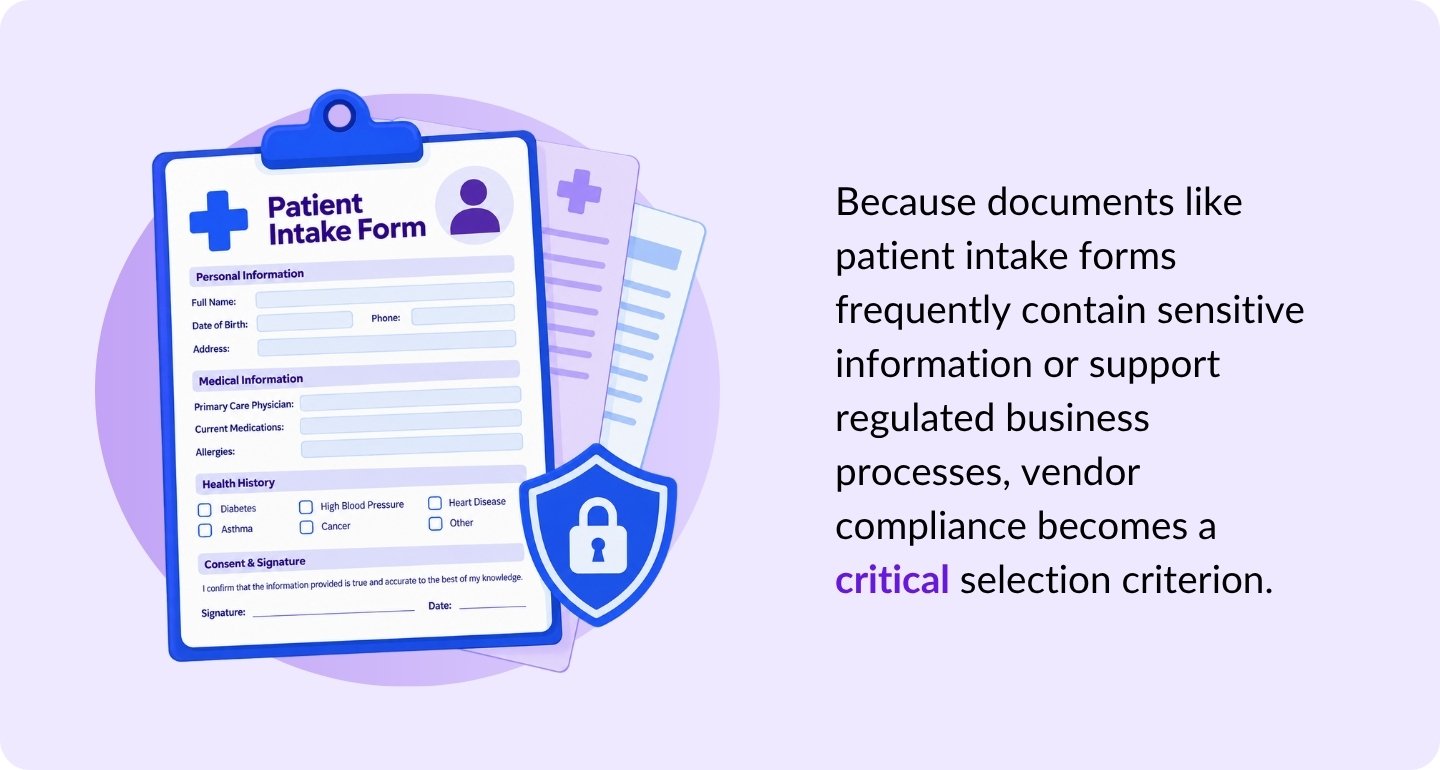
Because these documents frequently contain sensitive information or support regulated business processes, vendor compliance becomes a critical selection criterion. A vendor may produce high-quality documents at a competitive price, but if it cannot demonstrate adequate security controls, audit readiness and documented operating procedures, it may introduce unacceptable business risk.
For procurement teams, evaluating business forms vendor compliance means determining whether a provider can consistently protect information, maintain document integrity and support regulatory requirements across every stage of the workflow.
What is a regulated workflow and what are some examples in the context of business forms?
A regulated workflow is a business process subject to legal, regulatory, contractual or audit requirements. These workflows often require documented controls, restricted access, retention policies, change management procedures and evidence that information has been handled appropriately.
When printed forms or controlled documents move through regulated processes, the vendor becomes part of the organization's compliance ecosystem. See below for some real-world examples where selecting a business forms vendor is actually a strategic risk-management decision.
A healthcare provider selecting a patient forms vendor
Healthcare organizations routinely manage patient intake forms, consent documents, authorizations and other records that may involve protected health information. Procurement teams must verify that vendors have appropriate safeguards, contractual protections and documented procedures for handling sensitive information.
In addition to print quality and fulfillment capabilities, healthcare organizations should examine security controls, employee training programs and incident response procedures. These controls help support compliance objectives throughout the document lifecycle.
A financial institution outsourcing account statements
Banks, credit unions and financial service organizations often rely on external partners for high-volume statement production and related communications. These documents may contain account information, personally identifiable information and other highly sensitive content.
The selected provider must demonstrate strong information-security controls, production accuracy and auditable operating procedures. Procurement teams should closely evaluate access controls, document reconciliation processes and secure destruction practices.
An insurance carrier managing high-volume forms fulfillment
Insurance organizations frequently depend on large-scale forms fulfillment services to distribute policy documents, claims forms and compliance notices. Errors in fulfillment processes can create customer-service challenges and regulatory complications.
A provider supporting regulated insurance communications should be able to demonstrate traceable workflows, documented quality controls and the ability to support ongoing audit activities. Strong operational governance is often just as important as production capacity.
What makes a business forms vendor truly compliant?
A truly compliant business forms vendor does more than claim to follow best practices. Compliance should be supported by documented controls, independent assessments, employee training, security governance and repeatable operational procedures.
Strong business forms vendor requirements typically include:
- Formal security policies
- Controlled production environments
- Role-based access controls
- Visitor management procedures
- Incident response plans
- Data retention controls
- Secure document destruction procedures
- Vendor oversight programs
- Internal audit practices
- Compliance reporting capabilities
The most mature providers treat compliance as an organization-wide discipline rather than a sales checkbox. Procurement teams should look for evidence that compliance responsibilities are embedded throughout the business.
How can procurement teams evaluate, compare and select the right business forms management provider?
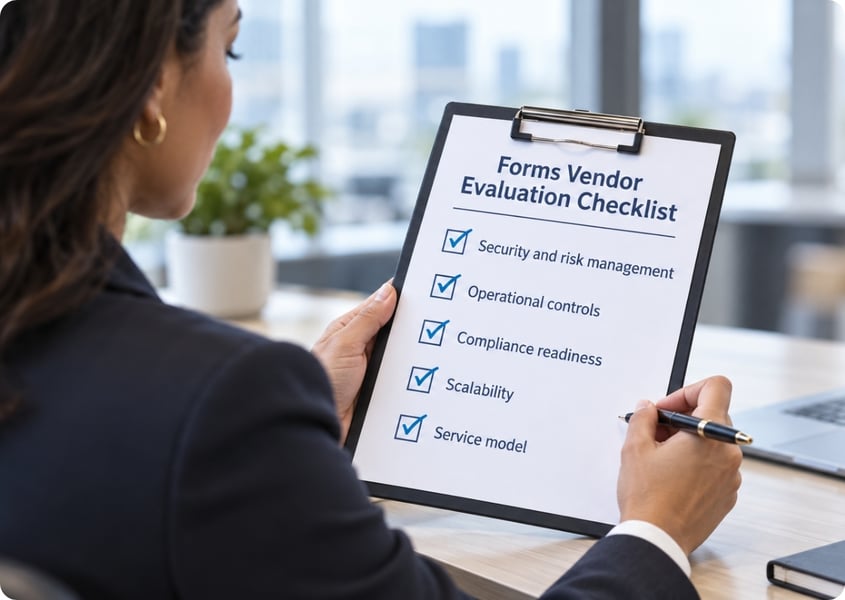
A structured procurement approach helps organizations approach print management outsourcing strategically — comparing vendors objectively while reducing risk. An effective forms vendor evaluation checklist should assess five major areas:
Security and risk management
Evaluate whether the managed print service provider maintains documented security programs, risk assessments and security governance processes. Mature vendors can clearly explain how risks are identified, monitored and mitigated.
This area is particularly important for organizations with formal vendor risk management programs that require ongoing oversight of third-party providers.
Operational controls
Assess production workflows, change management procedures and quality assurance programs. Procurement teams should understand how the vendor ensures consistency, accuracy and accountability throughout the document lifecycle.
Operational maturity is often a significant differentiator among providers offering similar production services.
Compliance readiness
Determine whether the provider can support audits, produce documentation on request and demonstrate adherence to applicable regulatory requirements.
Organizations with complex regulated workflows often require ongoing audit support and evidence of compliance activities.
Scalability
A provider should be capable of supporting growth without compromising security or quality standards. This is particularly important when evaluating bulk business form printing services and enterprise-scale fulfillment operations.
Procurement teams should ask about capacity planning, business continuity and disaster recovery capabilities.
Service model
Evaluate inventory management, reporting capabilities, technology integrations and support resources. The strongest providers combine production expertise with comprehensive business form management services.
What certifications and security controls should procurement require from a business forms vendor?
Third-party validations can provide important evidence that a vendor has implemented meaningful security and compliance controls. While certifications alone do not guarantee compliance, they are valuable indicators of organizational maturity. Make sure your vendor selection process explores all of the following third-party validations in depth.
SOC 2 Type II
SOC 2 Type II assessments evaluate controls related to security, availability, confidentiality, processing integrity and privacy over a defined period of time. For procurement teams, SOC 2 Type II reports provide independent validation that controls are operating effectively rather than merely existing on paper.
This certification is often considered a baseline requirement for enterprise vendor selection.
ISO 27001
ISO 27001 is an internationally recognized information security management standard that requires organizations to implement a systematic approach to managing information-security risk.
Providers that maintain ISO 27001 certification typically demonstrate mature governance processes, risk-management methodologies and continuous improvement practices.
HIPAA BAA
Organizations handling healthcare-related information may require a HIPAA Business Associate Agreement (BAA) when a provider supports activities involving protected health information.
Procurement teams within healthcare environments should verify whether a vendor can execute and support applicable HIPAA obligations as part of its service model.
SOX Attestation
Publicly traded companies often require vendors supporting financial reporting processes to demonstrate controls that align with Sarbanes-Oxley expectations.
A SOX-related attestation or documented control framework can help procurement and audit teams assess whether appropriate financial-process controls are in place.
PCI-DSS
Providers handling payment-card information should maintain compliance with the Payment Card Industry Data Security Standard (PCI-DSS). Even when payment information represents only a small portion of the workflow, procurement teams should understand how sensitive payment data is protected and segregated.
Together, these certifications form a valuable vendor compliance checklist that can help organizations compare providers more effectively during the selection process.
The secure facilities checklist
As the various certifications described above indicate, physical security is a vital component of business forms vendor compliance. Even the strongest cybersecurity program can be undermined if facilities lack adequate protections.
When conducting a business forms vendor evaluation, procurement teams should confirm the presence of:
-
- Controlled facility access
- Badge-based entry systems
- Visitor sign-in procedures
- Visitor escorts
- Video surveillance systems
- Secure production areas
- Restricted-access storage locations
- Documented key-management procedures
- Environmental monitoring controls
- Secure loading and shipping areas
- Asset tracking processes
- Certified secure destruction procedures
- Employee background-screening programs
- Security awareness training
- Incident response procedures
These controls help protect sensitive forms and support compliance requirements throughout physical production and fulfillment processes.
What chain-of-custody documentation should procurement look for?
The term chain of custody refers to the documented record of who handled a document, material or asset throughout its lifecycle.
In the context of business forms management, chain-of-custody documentation helps demonstrate accountability and traceability from production through storage, fulfillment and destruction. Procurement teams should seek evidence that these procedures are documented, consistently followed and available for audit review.
A strong chain-of-custody program typically includes:
- Documented receipt procedures
- Inventory tracking controls
- Production accountability records
- Access logs
- Shipment verification documentation
- Reconciliation reporting
- Exception management procedures
- Secure destruction records
Organizations operating highly regulated programs should ensure vendors can produce supporting documentation when requested by audit, compliance or legal stakeholders.

What trade-offs must be considered when choosing a compliant business forms vendor?
Of course, every procurement decision involves balancing competing priorities. Understanding these trade-offs can help organizations make informed decisions without introducing unnecessary risk. Be sure to consider the following trade-offs when determining which compliant business forms vendor offers the best “fit” for your organization.
Cost vs. compliance risk
Lower-cost providers may appear attractive during sourcing exercises, but inadequate controls can generate substantial downstream costs. Regulatory issues, remediation expenses, operational disruptions and reputational damage can quickly eclipse short-term savings.
Procurement teams should evaluate total risk exposure rather than focusing solely on unit pricing.
Speed vs. control
Organizations often want faster production cycles and rapid deployment of forms programs. However, robust approval processes, quality controls and security procedures can add necessary safeguards.
The goal is not maximum speed. The goal is dependable execution that supports compliance, accuracy and accountability.
Flexibility vs. standardization
Highly customized workflows can improve user experience and operational efficiency. At the same time, excessive customization may increase complexity and audit challenges.
Strong providers typically balance flexibility with standardized operating procedures that support consistency and compliance.
Red flags in vendor RFP responses
Certain RFP responses should trigger additional scrutiny during the procurement process. Examples include:
-
- Vague answers regarding security controls
- Reluctance to discuss audits or certifications
- Missing documentation requests
- Lack of formal incident response procedures
- Inability to explain chain-of-custody controls
- No documented business continuity planning
- Limited access-control descriptions
- Undefined subcontractor oversight practices
- Absence of compliance reporting capabilities
- Overreliance on verbal assurances instead of documented evidence
These warning signs may indicate weaknesses in the provider's governance framework and should be evaluated carefully.
Putting it all together: Building your procurement checklist for business forms vendors
Choosing the right forms provider requires a comprehensive evaluation of security, compliance, operational controls and service capabilities. Procurement teams that understand how to choose a compliant business forms vendor are better positioned to reduce risk, support audit preparedness, and protect critical business processes.
A successful procurement checklist for business forms vendors should examine certifications, facility security, chain-of-custody procedures, audit support capabilities and operational governance. When combined with a structured vendor compliance checklist, these requirements can help organizations identify a trusted partner capable of supporting complex enterprise forms management, forms fulfillment services, bulk business form printing services and highly regulated workflows.
Taylor: Your compliant business forms partner
Taylor has more than 50 years of experience with large-scale corporate printing services and print management solutions. Roughly 80% of Fortune 500 companies trust Taylor to optimize their corporate printing programs and with good reason.
Taylor’s diverse print production technologies enables us to excel at both bulk business forms and custom business forms printing. We are also renowned for our expertise with business check printing and the stringent security and compliance requirements they entail. Combine the two and Taylor is uniquely positioned to provide the compliant business forms production necessary to support regulated workflows in financial services, healthcare, insurance, government and other industry sectors.
Looking for a compliant business forms vendor who offers the built-in security measures, compliance rigor and operational controls you need? Contact Taylor to learn about our special expertise with compliant business forms management.
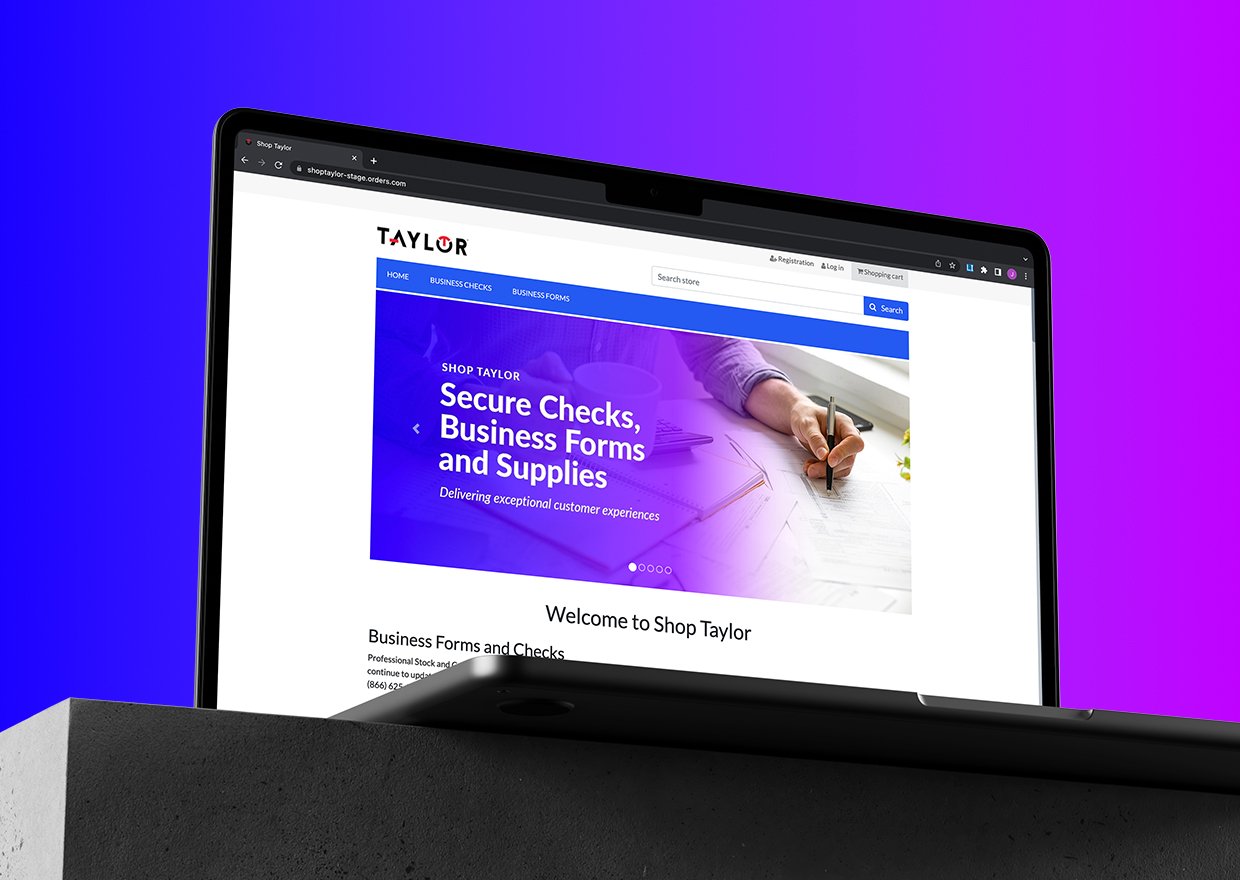
Need compliant forms fast? For lower-volume orders, quick replenishment or on-demand business forms, visit Shop Taylor for secure, compliant forms delivered when and where you need them.


.jpg)