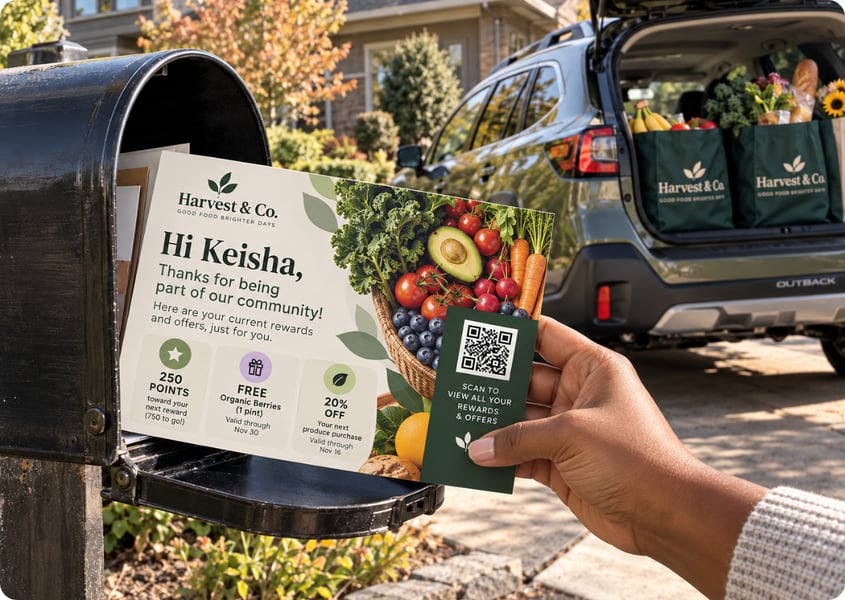
The retail customer journey rarely happens within a single channel. Consumers may discover products through social media, browse a retailer's website, compare options on a mobile device, visit a store and ultimately make a purchase through an app or ecommerce site. That complexity creates an opportunity for physical mail to serve as another strategically coordinated customer touchpoint rather than as a stand-alone advertising tactic. The USPS® describes direct mail as an offline signal that can complement digital interactions within a larger customer journey.
The biggest change is what happens before and after the mail piece enters the mailbox. Modern data-driven marketing practices allow retailers to draw on purchase histories, customer lifecycle stages, geographic signals, demographic information and behavioral data to create more meaningful audience segments. Variable data printing can then translate those insights into differences in offers, imagery, messaging and calls to action.
This is increasingly where AI-powered direct mail marketing for retailers enters the picture. AI can help marketers turn clean customer data into decisions about targeting, personalization and resource allocation while measurement tools help connect the physical interaction back to business outcomes.
Keep reading to learn how AI — when applied to clean, enriched data — can help retailers turn customer information into actionable decisions across physical and digital channels.
- Why does direct mail still work?
- What is retail direct mail marketing and what are the key benefits?
- What are some real-world uses of retail direct mail marketing?
- New location and open house announcements
- Brand recognition campaigns
- Loyalty program engagement
- Lapsed customer reactivation
- Omnichannel QR code campaigns
- How is AI transforming retail direct mail marketing?
- What is AI-powered personalization for direct mail?
- How can retailers use AI to personalize direct mail campaigns?
-
- AI-powered product recommendations
-
- First-party data
- Customer segmentation
- What are some trade-offs to consider when implementing retail direct mail marketing strategies?
- Personalization vs. privacy
- Reach vs. precision targeting
- Acquisition vs. retention
- Short-term promotions vs. long-term loyalty
- Print costs vs. campaign performance
- How can retailers maximize direct mail ROI through measurement?
- Conclusion: The future of retail direct mail marketing is more connected
Why does direct mail still work?
Research indicates that direct mail continues to resonate with consumers across generations. According to Lob’s 2025 State of Direct Mail Consumer Insights report, 84% of consumers read direct mail the same day they receive it and 81% say they are more likely to re-engage with a brand after receiving a direct mail piece. Perhaps more surprisingly, direct mail’s appeal extends to younger, digitally native audiences. Lob’s study found that a remarkable 85% of Gen Z and Millennials engage with direct mail. It also found that 58% of consumers feel overwhelmed by digital brand messages while 53% say direct mail now feels more special, valuable or exclusive.
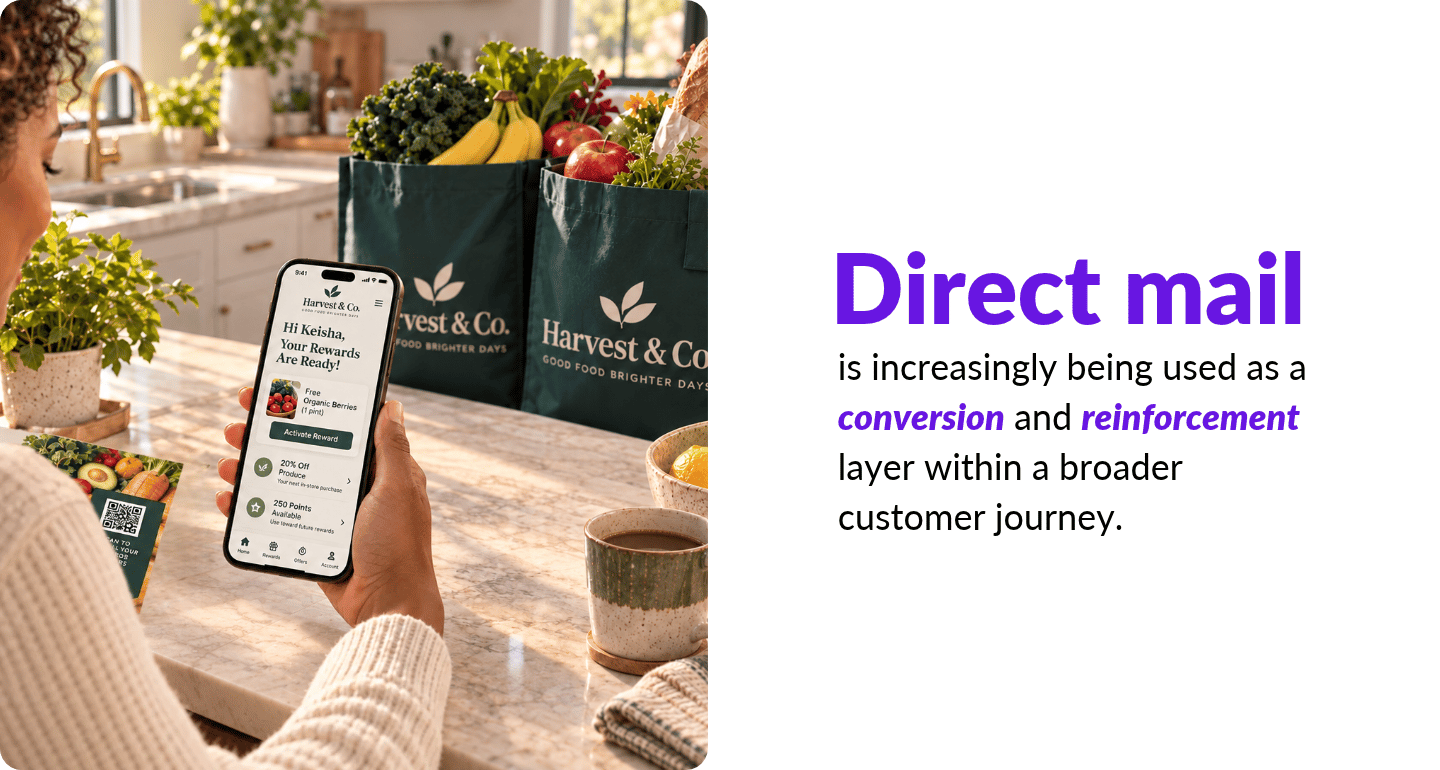
That’s because direct mail offers something increasingly distinctive within a digitally saturated marketing environment: a physical interaction. Rather than replacing email, paid social, search or other digital tactics, mail can reinforce those experiences and provide another opportunity for customers to engage with a retailer. Direct mail is increasingly being used as a conversion and reinforcement layer within a broader customer journey.
Its physical nature is only half the story. The channel has evolved considerably in terms of targeting, personalization and measurability. QR codes, personalized URLs, and coordinated digital experiences can connect a printed communication to online activity, potentially making the mail piece both a customer touchpoint and a measurable signal within a larger campaign.
That evolution changes the definition of retail direct mail best practices. Effective direct mail marketing is less about mailing the largest possible audience and more about identifying the right audience, delivering a relevant communication at an appropriate point in the journey, and measuring what happens next. This is especially important when one considers the fact that direct mail programs typically require six to eight “touches” — or more — to effectively engage a targeted consumer.
What is retail direct mail marketing and what are the key benefits?
Retail direct mail marketing is the use of targeted physical mail to communicate with retail prospects and customers. Campaigns can support acquisition, promotions, customer retention, cross-selling, reactivation and other objectives using audience data to help determine who receives the communication and which message they see.
Among the most important benefits of direct mail for retailers is its flexibility across the customer lifecycle. A retailer can use prospect information to support acquisition while established customer data can inform retention or cross-sell communications. Recency and past customer behavior can also help define audiences for win-back programs.
Sophisticated direct mail marketing services can help retailers connect data management, segmentation, variable production, postal execution and measurement rather than managing each independently. For enterprise retailers, that integration becomes especially valuable when campaigns involve large audiences, multiple locations, multiple creative versions or frequent campaign cycles.
What are some real-world uses of retail direct mail marketing?
Understanding how retailers use direct mail marketing is easiest when the channel is viewed through specific customer objectives. Retailers can adjust the audience, message, offer, timing and response mechanism according to whether the goal is strengthening an existing relationship, winning back a customer, or stimulating an online or in-store purchase.
Importantly, these campaigns do not need to operate independently of the retailer's CRM or digital marketing program. Read the following examples to discover how data can inform audience selection while variable production translates that information into personalized communications and digital response mechanisms that move the interaction forward.
New location and open house announcements
Direct mail can help retailers build awareness and generate traffic when opening a new location, relocating an existing store or hosting an open house or grand opening event. Geographic targeting allows the retailer to focus communications on households within a defined trade area rather than promoting the event to a broader audience with little likelihood of visiting.
Retailers, for example, often vary messaging or offers based on proximity to the location, customer status or other audience characteristics. Adding an incentive, QR code or event-specific call to action can also give recipients a reason to visit while helping the retailer measure response to the campaign.
Brand recognition campaigns
Direct mail does not always need to center on an immediate purchase or promotional offer. Retailers can also use mail to build brand recognition by introducing the company, reinforcing its positioning or highlighting products, services and differentiators that help establish a distinctive presence in the market.
For example, a retailer might use a series of visually consistent mail pieces to reinforce its brand story, showcase signature product categories or communicate what sets the business apart. Repeated exposure can help keep the brand familiar and recognizable, supporting future consideration when a recipient is ready to make a purchase.
Loyalty program engagement
Direct mail can extend loyalty marketing beyond email and mobile notifications. Members could receive communications tied to loyalty status, purchase patterns, available rewards or relevant product categories, helping the retailer make the message more useful than a generic promotional mailing.
For example, different loyalty segments might receive different rewards, merchandise categories or calls to action. This allows mail to become part of ongoing customer journey marketing rather than simply another periodic promotional blast.
Lapsed customer reactivation
Customer recency is a particularly useful signal for direct mail because it allows a retailer to distinguish active buyers from people whose purchasing activity has declined. A reactivation audience can be defined according to factors such as purchase history, elapsed time since the last transaction and previous engagement.
From there, retailers can apply behavioral targeting to vary messages or offers according to what they know about the customer. A former high-frequency shopper, for example, may warrant a different strategy than someone who made one purchase and never returned.
Omnichannel QR code campaigns
Direct mail can become an entry point to a digital experience when a mail piece includes a QR code that takes the recipient to an appropriate online destination. Ideally, that experience continues the campaign's message and offer rather than sending every customer to a generic homepage. The “destination” should continue the message introduced through the physical piece.
This is an important application of omnichannel marketing because physical and digital channels are assigned complementary roles. QR codes and PURLs are especially effective when used to create measurable connections between offline and online interactions.

How is AI transforming retail direct mail marketing?
AI adds a decision-making layer to the data infrastructure already supporting targeted mail. Instead of relying exclusively on manually constructed rules and segments, marketers can apply AI and predictive analytics to customer information to uncover patterns, prioritize audiences, and inform decisions about targeting and personalization.
That makes AI-powered direct mail particularly relevant to retailers with large customer bases and extensive transaction histories. AI can help transform those records into intelligence about what may matter to particular audiences while marketing teams retain control over campaign objectives, approved creative, offers and business rules.
The underlying data remains crucial as AI is only as effective as the data powering it. Having access to clean, enriched customer data is vital to turning AI-generated insights into actionable marketing decisions.
What is AI-powered personalization for direct mail?
AI-powered personalization combines customer data and AI-assisted decisioning with technologies such as variable data printing. Rather than merely placing a person's name on otherwise identical creative, retailers can potentially vary products, offers, messages, imagery or other content based on what is known about an audience or customer.
This is where AI-powered direct mail services can expand on traditional database-driven personalization. AI can support decisions about which available creative treatment or offer is most appropriate while variable printing turns those decisions into individualized or segmented physical communications.
The distinction is important: AI does not eliminate the need for strong data strategy or creative strategy. It gives marketers another way to analyze information and make decisions at a scale that would be difficult to manage manually.
How can retailers use AI to personalize direct mail campaigns?
A practical starting point is to connect AI to defined marketing objectives. A retailer might seek to identify customers with the greatest likelihood of responding, distinguish among audience groups, or determine which approved offer or product category is most appropriate for each segment.
This approach can also support direct mail automation. Behavioral or lifecycle signals can initiate predefined workflows so that relevant mail enters production when specified customer conditions are met instead of waiting for a large scheduled campaign. Automation can consequently make direct mail feel more closely connected to the timing of digital CRM communications.
Retailers evaluating personalized direct mail services should therefore look beyond variable-name printing. The larger opportunity is the ability to connect usable customer data with segmentation, personalization logic, automated execution and measurement.
AI-powered product recommendations
Product recommendations offer a clear retail use case for AI-assisted personalization. Purchase history, customer preferences and other relevant signals can help determine which product categories or approved creative assets should appear in the communication. Personalized retail offers informed by purchase history and customer preferences are a powerful application of variable mail.
Consider a specialty retailer with customers who buy across distinct categories. Instead of featuring one assortment for the entire database, the retailer could use customer information to determine which category or offer is most relevant to different recipients. The result is a piece designed around customer relevance rather than simply mail-merge personalization.
What types of customer data produce the most effective direct mail personalization?
The most useful data is information that helps answer a campaign question. Retailers may draw on purchase behavior, recency, lifecycle stage, geography, loyalty information and previous engagement, depending on the purpose of the mailing.
Effective mail-based data-driven marketing solutions should also account for data quality. Adding more variables does not automatically create better personalization. Read the examples below to learn how reliable, actionable information that connects directly to the campaign objective is generally more useful than accumulating data simply because it is available.
First-party data
First-party information may include transaction history, loyalty activity, stated preferences and other data collected through a retailer's own customer relationships. It can be especially valuable because it provides direct insight into how known customers have interacted with the brand.
A strong first-party data marketing strategy can connect these signals to meaningful campaign decisions. Instead of merely knowing that someone is a customer, a retailer can determine whether that relationship provides a legitimate reason to alter the offer, timing or content of a mail piece.
Customer segmentation
Segmentation organizes customers or prospects into meaningful groups based on shared characteristics. Those groups could reflect geography, purchase patterns, customer lifecycle stage, previous engagement, or other factors that support the campaign objective.
Segmentation also provides a useful bridge between one-size-fits-all communications and one-to-one personalization. A retailer may discover that a manageable number of strategically meaningful groups produces most of the benefit without creating the data, creative and production complexity involved in individualizing every element for every recipient.
What are some trade-offs to consider when implementing retail direct mail marketing strategies?
Better technology does not eliminate strategic trade-offs. In fact, greater targeting and personalization capabilities give marketers more decisions to make about data, audience size, campaign economics and customer experience.
The strongest retail direct mail best practices therefore are not necessarily about maximizing everything. Explore the trade-offs below and consider how personalization, precision and automation can meaningfully improve performance without adding unnecessary cost or complexity.
Personalization vs. privacy
More customer information can support stronger personalization, but retailers should not assume that every available data point belongs in the creative. Personalization works best when the connection between the customer's relationship with the brand and the communication feels natural and useful.
Retail organizations also need to operate within applicable privacy requirements, consent frameworks and their own data governance policies. The goal is relevant personalization, not proving to a customer how much the retailer knows.
Reach vs. precision targeting
Precision can reduce wasted communications by concentrating resources on higher-potential audiences. However, progressively tightening targeting criteria inevitably narrows the eligible audience, so a campaign designed for highly efficient conversions may look very different from one intended to build broad awareness.
Marketers should define the campaign objective before deciding how narrow the audience should become. This keeps targeting strategy tied to business outcomes instead of treating greater precision as inherently better.
Acquisition vs. retention
Acquisition campaigns must often work with less first-party behavioral information than programs targeting established customers. Retention campaigns can potentially draw on richer transaction and loyalty histories while acquisition programs may depend more heavily on prospect, geographic or other permissible targeting data.
Those differences should influence the offer, economics and measurement framework. The right mailing strategy for finding new customers may not be the right strategy for increasing the value of existing relationships.
Short-term promotions vs. long-term loyalty
Promotional mail can be designed around an immediate action, such as visiting a store, scanning a QR code or purchasing during a defined event. Loyalty marketing, however, asks marketers to consider the cumulative customer relationship and the role each communication plays within it.
Retailers should therefore avoid allowing short-term conversion goals to dominate every interaction. Some mail can be oriented toward immediate revenue while other communications support recognition, exclusivity or ongoing engagement.
Print costs vs. campaign performance
Printing, personalization, production and postage make cost discipline essential. Yet evaluating a campaign simply by its cost per piece can be misleading if it ignores response, conversion, customer value or incremental revenue.
Measurement should instead connect campaign investment with business outcomes. A smaller, more expensive personalized mailing may outperform a lower-cost mass mailing if its stronger targeting and relevance generate enough incremental value to offset the additional investment.
How can retailers maximize direct mail ROI through measurement?
The evolution of direct mail becomes especially important at the measurement stage. QR codes and PURLs can generate direct response signals while retailers can also evaluate conversion rate, cost per acquisition, average order value and revenue outcomes. Incorporating offline direct mail signals into attribution can provide a more complete view of a customer journey that spans physical and digital interactions. There is tremendous value in understanding the initial point of engagement.
More sophisticated campaign attribution can also help marketers move beyond asking which single channel "caused" a sale. Direct mail might introduce an offer that a consumer later searches for online, or it may reinforce a message first encountered elsewhere. Looking at the combined system helps marketers evaluate how channels work together rather than forcing every interaction into a single-channel model.
Finally, testing should be built into the program. Holdout groups, audience tests, offer comparisons and creative testing can help marketers distinguish incremental performance from activity that might have occurred anyway. That learning can then feed the next campaign, helping teams steadily improve direct mail ROI rather than treating measurement as something that happens only after production is complete.
Conclusion: The future of retail direct mail marketing is more connected
The transformation of direct mail is not really a story about print becoming digital. It is about physical mail gaining access to the same disciplines that have reshaped the rest of marketing: customer data, analytics, automation, AI-assisted decisioning, and increasingly sophisticated measurement.
For retailers, that marketing integration creates an opportunity to use mail more selectively and strategically. The next generation of retail direct mail marketing can be informed by customer behavior — personalized around meaningful insights, triggered at relevant moments, and connected to digital experiences that continue the conversation.
The most effective programs will bring these capabilities together. When data-driven marketing, AI, personalization, automation, omnichannel execution and rigorous measurement operate as parts of the same strategy, direct mail becomes more than something retailers send. It becomes a measurable component of how they acquire, retain and engage customers throughout the retail journey.
Taylor: AI-powered direct mail marketing for retailers
Taylor is a trusted partner to the retail industry and provides a wide range of services to retailers nationwide — including direct mail marketing services like those described above.
- All forms of direct mail are available through Taylor including direct mail postcards, self-mailers, personalized letters, custom-kitted direct mail packages and more.
- When retailers work with Taylor, they have access to everything from design and copywriting to data sourcing, audience segmentation strategies, mailing execution and results measurement on the back-end — all through a single marketing partner.
- We support omnichannel marketing campaigns that integrate direct mail with QR codes, personalized URLs (PURLs) and other tactics to deliver a seamless customer experience.
- Throughout all of this, Taylor utilizes the latest AI-powered tools and tactics to deliver a stronger ROI on every marketing dollar spent.
Looking for a retail direct mail marketing service that is well versed in both data-driven marketing solutions and omnichannel marketing? Contact Taylor to learn about our expertise with AI-powered direct mail services for retailers.