As supply chains become increasingly complex, organizations are under constant pressure to fulfill orders faster while controlling costs and maintaining service quality. Operations leaders, procurement teams and logistics professionals continually seek ways to improve efficiency without adding unnecessary labor, warehouse space or technology investments.
One strategy that has emerged as a powerful operational tool is kitting services. By grouping multiple products or components into a single preassembled package, organizations can streamline fulfillment workflows, reduce handling requirements and improve consistency across supply chain operations.
Understanding how kitting services reduce fulfillment costs can help decision-makers evaluate whether kitting represents an opportunity to optimize their own fulfillment networks. Read the blog below to learn about the role of kitting and fulfillment services in modern supply chain optimization strategies.
- What are kitting services all about and how do they relate to other key aspects of logistics operations?
- Supply chain management
- Warehouse management
- Inventory control
- Order fulfillment
- Distribution services
- Third-party logistics (3PL)
- How does kitting improve supply chain operations?
- How can kitting services reduce operational and fulfillment costs?
- How does kitting improve order accuracy and customer satisfaction?
- When is a kitting process advantageous and when should it be used?
- When orders frequently contain multiple items
- When fulfillment errors are impacting customer satisfaction and operational performance
- When labor costs and picking time need to be reduced
- What are some real-world examples of kitting and fulfillment services in action?
- Retail product bundles
- Subscription box fulfillment
- Healthcare kitting and fulfillment
- Promotional marketing kits
- What are the trade-offs of implementing supply chain kitting solutions?
- Upfront planning vs. long-term efficiency
- Customization vs. scalability
- Inventory investment vs. faster fulfillment
- In-house kitting vs. outsourced kitting services
What are kitting services all about and how do they relate to other aspects of logistics operations?
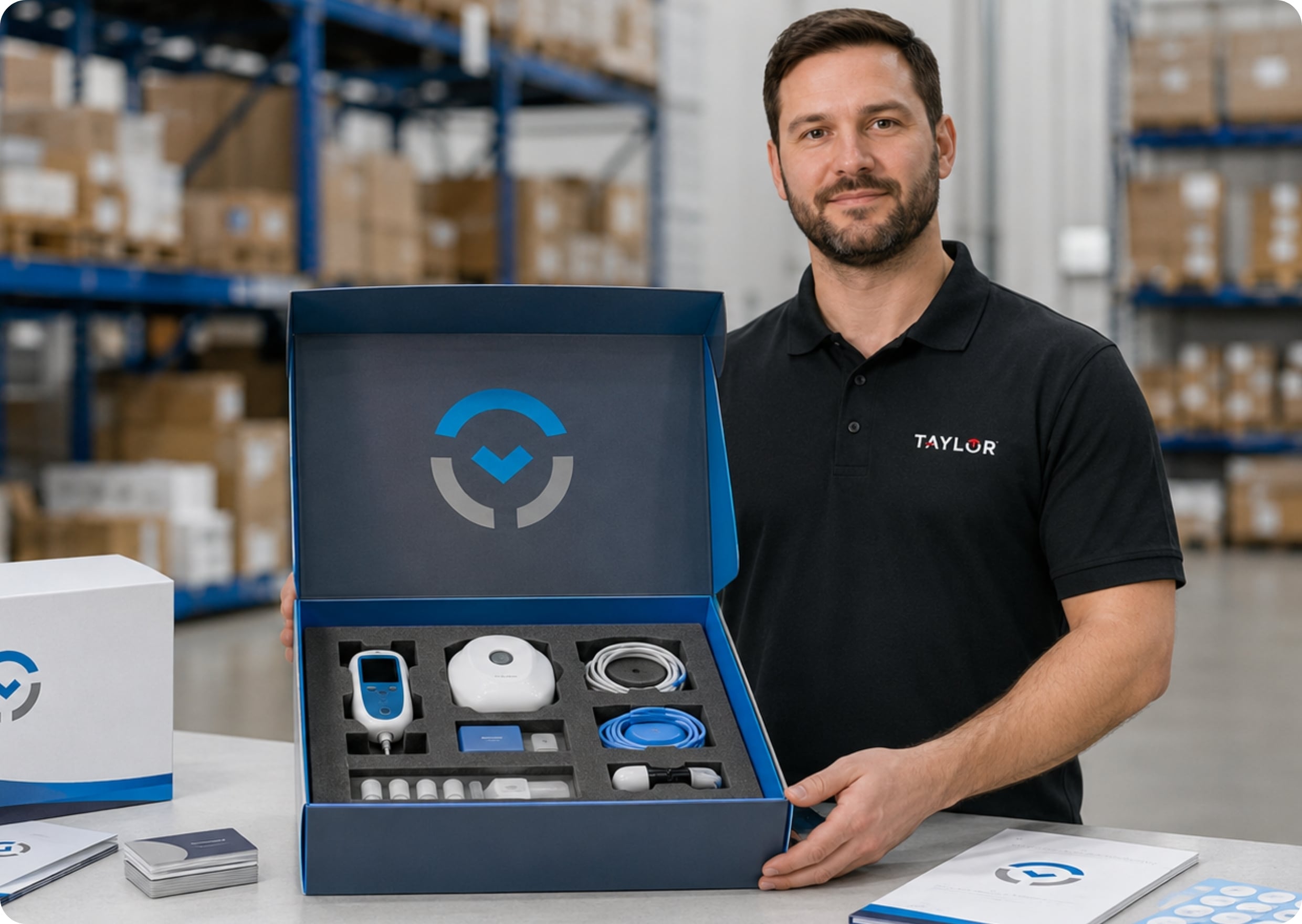
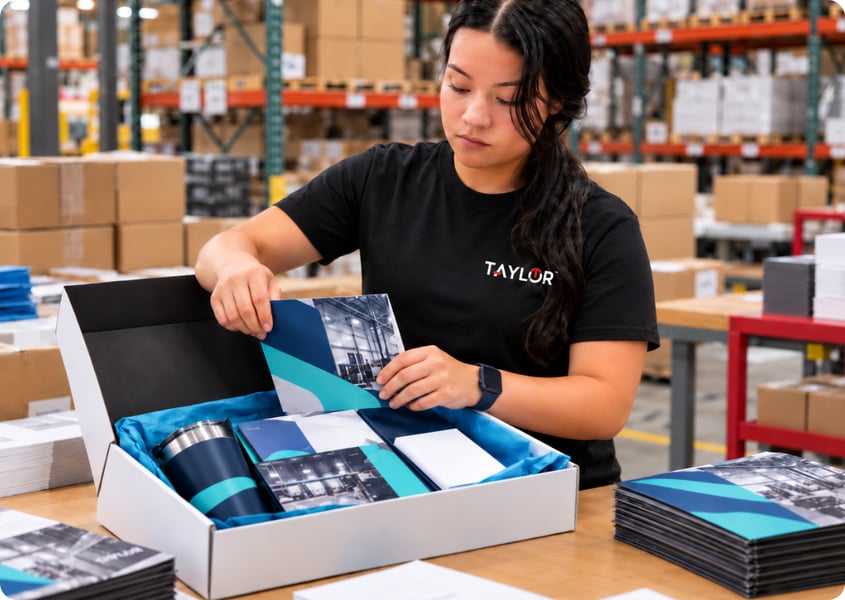
As a core concept, kitting services involve assembling multiple products, components or materials into a single package that can be stored, managed and shipped as one unit. Rather than requiring fulfillment personnel to locate and pick multiple items every time an order is received, the items are grouped together beforehand into a completed kit.
While kitting may appear to be a simple packaging activity, it directly impacts several areas of logistics and supply chain management. Keep reading to learn how kitting often serves as a bridge between inventory management, warehousing and fulfillment operations.
Supply chain management
Within supply chain operations, kitting supports broader goals related to efficiency, cost reduction and process standardization. Effective supply chain kitting solutions help reduce fulfillment complexity while creating more predictable inventory and distribution workflows.
By consolidating multiple products into a single unit, organizations often gain greater visibility into demand patterns while simplifying replenishment processes. This contributes to overall supply chain optimization and stronger operational performance.
Warehouse management
Warehouse operations often benefit significantly from kitting because fewer individual items must be picked for each order. Preassembled kits reduce travel time throughout the warehouse and allow fulfillment teams to process orders more quickly.
As order volumes grow, warehouse managers frequently discover that kitting can improve throughput without requiring proportional increases in labor or facility expansion.
Inventory control
Although kitting introduces additional planning requirements, it can make inventory management more efficient when implemented appropriately. Frequently ordered item combinations can be managed as kit inventory rather than individual order-line transactions.
This simplification often leads to important inventory management benefits, including improved inventory visibility and more consistent stock control processes.
Order fulfillment
Kitting directly supports faster fulfillment operations by reducing the number of touchpoints required during order assembly. Instead of picking multiple products from several warehouse locations, fulfillment personnel can retrieve a single preassembled kit.
The result is often higher fulfillment productivity and reduced processing times, particularly during peak order periods.
Distribution services
Distribution operations also benefit when kits are assembled in advance. Consolidated shipments typically require fewer packaging materials and may be easier to transport through distribution networks.
By reducing complexity within distribution workflows, organizations can improve consistency while lowering certain transportation and handling costs.
Third-party logistics (3PL)
Many businesses rely on third-party logistics providers to execute their kitting programs. Kitting and fulfillment services offered by 3PL providers often combine warehousing, assembly, packaging and distribution into a unified solution.
For organizations seeking scalability without major capital investments, outsourced providers can support growing product volumes while improving outsourcing supply chain efficiency across the fulfillment network.
How does kitting improve supply chain operations?
Kitting improves supply chain performance by reducing operational complexity. Every time a fulfillment associate picks an item, scans a barcode or packages a product, costs are incurred and errors become possible.
When products that are frequently ordered together are assembled into kits, organizations eliminate repetitive fulfillment activities. This streamlining improves workflow efficiency throughout receiving, storage, picking, packing and shipping operations.
Kitting can also strengthen coordination between procurement, warehousing and fulfillment departments. Because kit requirements are known in advance, procurement teams can better forecast component demand while warehouse managers can organize inventory around anticipated kit production schedules.
These improvements contribute directly to higher supply chain efficiency and support broader objectives related to supply chain optimization.
How can kitting services reduce operational and fulfillment costs?
Understanding how kitting services reduce fulfillment costs requires a closer look at the operational expenses that occur during order processing.
-
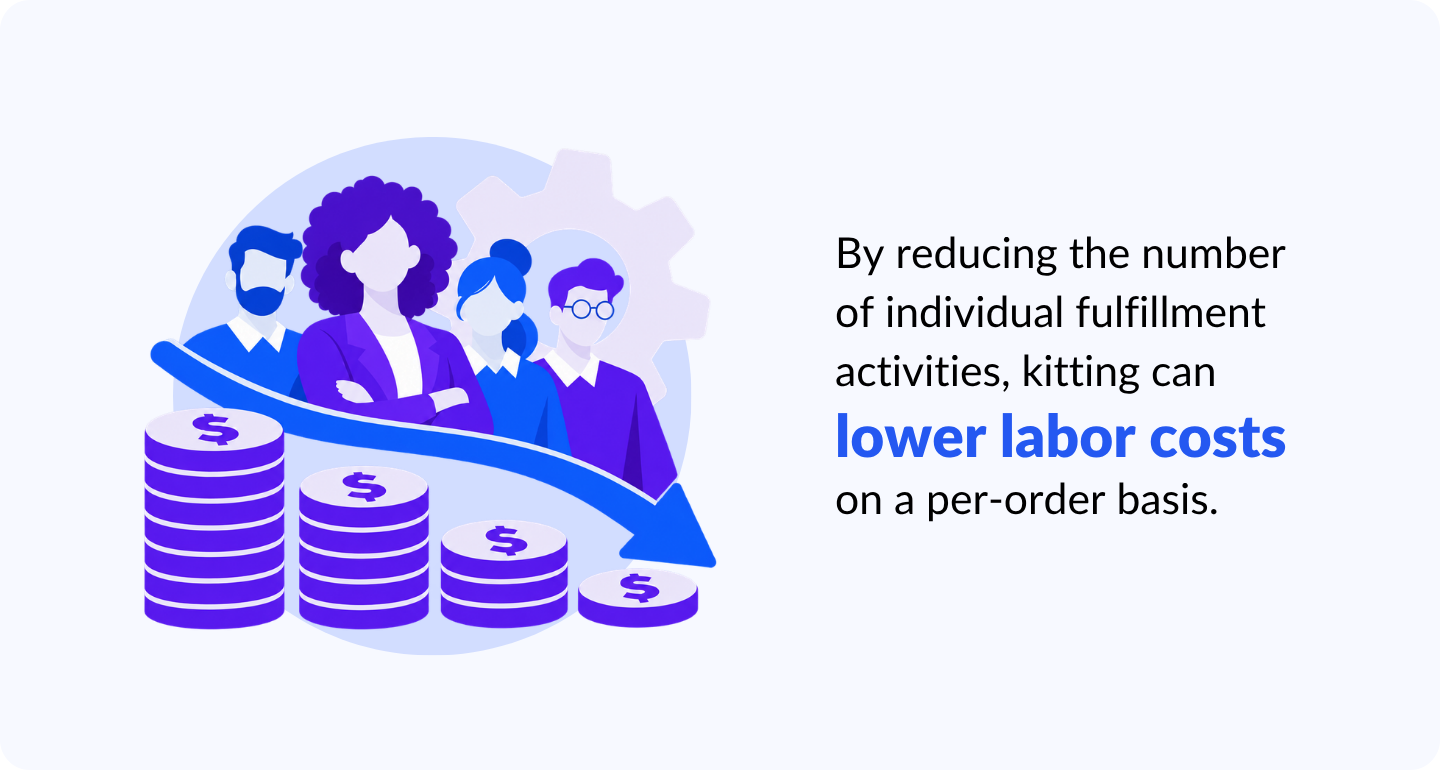
- One of the largest fulfillment expenses is labor. Every additional product that must be located, picked and packed increases labor requirements. By reducing the number of individual fulfillment activities, kitting can lower labor costs on a per-order basis.
- Kitting may also lower packaging costs. Multiple items bundled into a single kit often require less packaging material than separate product shipments. Reduced packaging usage can generate meaningful savings, particularly for high-volume operations.
- Shipping expenses may decrease as well. Consolidated kits can simplify carton selection and improve packing efficiency, potentially reducing dimensional weight charges and transportation costs.
- Organizations frequently realize additional savings through improved inventory optimization. Because kits are assembled according to demand forecasts and operational requirements, inventory can often be managed more strategically while reducing unnecessary handling and storage activities.
- In a manufacturing setting, providing pre-assembled kits of parts to the production staff can dramatically increase the efficiency of the manufacturing process. Label kitting for durable industrial labels is one increasingly common example.
For businesses experiencing rapid growth, these cumulative efficiencies can create substantial operational advantages over time.
How does kitting improve order accuracy and customer satisfaction?
One of the most compelling benefits of kitting is its ability to support improved order accuracy.
-
- Every individual product pick introduces the possibility of human error. Associates may select the wrong SKU, miss a required item, or package products incorrectly. As order complexity increases, error rates often rise accordingly.
- The kitting process reduces opportunities for mistakes by moving assembly activities upstream. Rather than building each order independently, kits are assembled according to standardized procedures before fulfillment occurs.
- As a result, organizations often experience higher fulfillment accuracy and greater overall order accuracy. Quality control processes can be focused on verifying kits before they enter inventory, reducing downstream errors.
- Customers benefit as well. Orders are more likely to arrive complete and correct, reducing returns, replacement shipments and customer service inquiries. Faster delivery and more reliable order fulfillment contribute directly to stronger customer satisfaction and improved brand perception.
For subscription programs, healthcare shipments and promotional campaigns, even small improvements in fulfillment accuracy can significantly enhance the customer experience.
When is a kitting process advantageous and when should it be used?
Not every fulfillment operation requires kitting. However, several business scenarios consistently demonstrate clear value from the kitting process. Consider whether any of these scenarios are relevant to your organization — and if supply chain efficiencies may be gained by implementing a kitting and fulfillment strategy.
When orders frequently contain multiple items
Organizations that routinely ship the same group of products together are often strong candidates for kitting. Common examples include product bundles, onboarding kits and promotional packages.
Rather than repeatedly assembling identical combinations during fulfillment, businesses can create kits in advance and streamline order processing. This reduces labor and increases consistency across fulfillment operations.
When fulfillment errors are impacting customer satisfaction and operational performance
High error rates often indicate excessive process complexity. When associates are required to handle numerous products within each order, the likelihood of mistakes increases.
Kitting can standardize assembly procedures while supporting improving order accuracy. By reducing fulfillment variability, organizations may decrease costly rework, replacement shipments and customer complaints.
When labor costs and picking time need to be reduced
Many fulfillment operations struggle with labor shortages or increasing labor expenses. In these environments, reducing travel time and handling requirements becomes a critical operational priority.
Preassembled kits minimize repetitive picking activities and simplify fulfillment workflows. As a result, organizations can often process more orders with the same workforce while strengthening overall supply chain efficiency.
What are some real-world examples of kitting and fulfillment services in action?
The flexibility of kitting and fulfillment services allows organizations across industries to apply kitting in different ways. See below to learn about some of the more common applications of supply chain kitting solutions.
Retail product bundles
Retailers frequently use product kitting to create seasonal promotions, gift sets and bundled product offerings. Combining related products into complete kits simplifies fulfillment while allowing retailers to offer curated purchasing experiences.
Product bundles can also support inventory balancing strategies by pairing complementary products and simplifying merchandising efforts.
Subscription box fulfillment
Subscription businesses depend heavily on consistent, repeatable fulfillment processes. Kitting enables operators to assemble recurring monthly shipments in advance rather than building every order individually.
This approach helps improve throughput, increase fulfillment accuracy and reduce costs associated with repetitive assembly tasks.
Healthcare kitting and fulfillment
Healthcare organizations frequently distribute kits containing medical supplies, at-home testing materials, educational resources or clinical trial components. Completeness and consistency are essential because missing items may disrupt care delivery or program participation.
Healthcare-focused logistics kitting services can help organizations maintain accuracy while supporting compliance, traceability and operational efficiency.
Promotional marketing kits
Marketing departments often distribute kits that contain printed materials, branded merchandise, product samples and sales resources. These initiatives are commonly used for trade shows, product launches and employee engagement programs.
Kitting simplifies distribution while ensuring recipients receive all required promo marketing products in a consistent format. This coordinated approach can improve campaign execution while reducing fulfillment complexity.
What are the trade-offs of implementing supply chain kitting solutions?
Like any operational strategy, supply chain kitting solutions involve trade-offs that decision-makers should evaluate carefully. Explore all of the following factors before implementing a kitting and fulfillment process in your organization.
Upfront planning vs. long-term efficiency
Successful kitting processes require detailed planning. Organizations must identify which products belong in kits, establish inventory rules and design assembly workflows.
Although implementation may require time and resources, the resulting efficiencies often deliver long-term operational benefits through reduced labor, higher accuracy and streamlined fulfillment processes.
Customization vs. scalability
Highly customized kits can create substantial value for customers and specific business programs. However, customization may increase complexity and reduce process standardization.
Organizations must balance the desire for personalized experiences against the need for scalable fulfillment operations.
Inventory investment vs. faster fulfillment
Kitting often requires assembling inventory before orders arrive. This approach may increase inventory investment because completed kits occupy warehouse space.
However, the trade-off is significantly faster order processing and improved responsiveness. Many organizations determine that the operational advantages outweigh the inventory carrying costs.
In-house kitting vs. outsourced kitting services
Companies must also decide whether to manage kitting internally or partner with providers offering outsourced kitting services. Internal operations provide direct control over processes and inventory. However, they may require investments in labor, warehouse capacity and operational expertise.
By contrast, outsourced kitting services allow organizations to leverage established infrastructure, specialized personnel and scalable fulfillment resources. Many businesses pursue this approach when evaluating opportunities for outsourcing supply chain efficiency improvements across their logistics networks.
Taylor: Outsourced kitting and fulfillment services
Taylor’s expertise with warehousing and fulfillment enables us to provide the types of outsourced kitting and fulfillment services described above. We specialize in custom supply chain optimization strategies built around kitting services and turnkey fulfillment.
All of the capabilities required to maximize outsourcing supply chain efficiency can be found in a single partner:
- Nationwide distribution network
- B2C-caliber ordering tools
- Rigorous warehouse inventory management processes
- Robust reporting, data and analytics
Looking for a kitting and fulfillment services partner who can improve order accuracy for your organization while reducing operational and fulfillment costs? Contact Taylor to learn more about our custom kitting services.