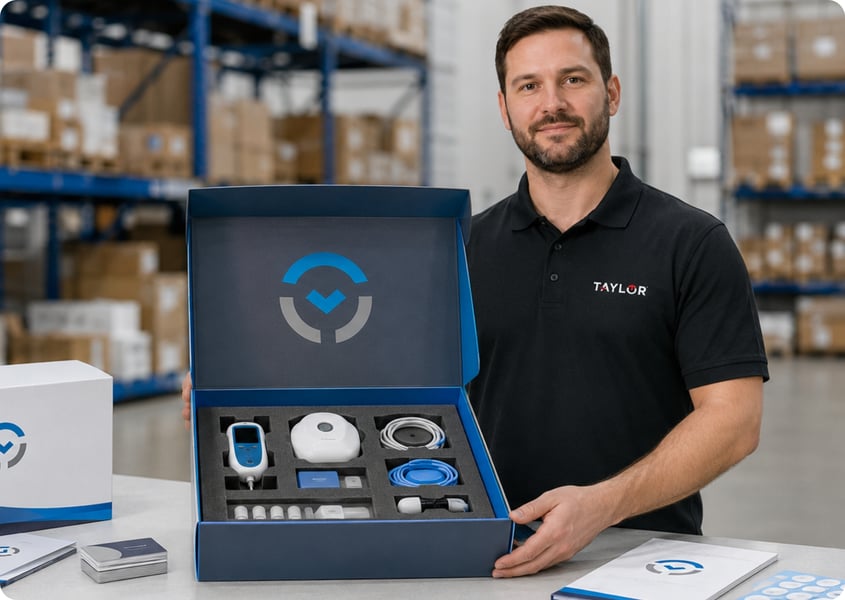
Manufacturers are under constant pressure to increase throughput, improve quality and reduce operational costs. At the same time, growing product customization and supply chain complexity can create bottlenecks that slow production and increase inventory challenges.
One proven strategy for addressing these challenges is the use of kitting in manufacturing environments. By organizing all required components before work begins, manufacturers can reduce wasted motion, minimize assembly delays and ensure production teams have the materials they need when they need them.
As Lean manufacturing principles continue to gain adoption across North America, kitting has become an increasingly important tool for improving operational performance. Keep reading to learn about the manufacturing kitting process and how kitting benefits manufacturers in a variety of industries.
- What is kitting in manufacturing and how does the process work?
- Material kitting
- Parts kitting
- Kitting vs. sub-assembly
- Product assembly
- What are the benefits of kitting in manufacturing operations?
- What are some real-world business examples of kitting in manufacturing?
- Electronics manufacturing
- Medical device manufacturing
- Industrial equipment manufacturing
- What are the trade-offs of kitting in manufacturing?
- Efficiency vs. upfront labor
- Inventory accuracy vs. process complexity
- Faster production vs. increased storage needs
- When should manufacturers outsource kitting and fulfillment services?
What is kitting in manufacturing and how does the process work?
At a high level, kitting in manufacturing involves collecting all materials, parts and components required for a particular production task and packaging them into a single kit. That kit is then delivered to the appropriate workstation, assembly line or production line. Instead of spending time gathering items from multiple storage locations, workers receive a complete package containing everything necessary to perform the job.
The manufacturing kitting process typically begins with a bill of materials (BOM), production order or work instruction. Required items are identified, picked from inventory, verified for accuracy and consolidated into a kit. Once assembled, the kit is delivered to production personnel, who can focus on value-added work rather than material retrieval. See below for a summary of key concepts that help define what kitting is and how it relates to the manufacturing workflow.
Material kitting
Material kitting refers to the collection of raw materials, consumables and production supplies needed for a manufacturing operation. These materials may include labels, packaging components, fasteners, adhesives, wiring, hardware or other items required to complete a production task.
By implementing material kitting, manufacturers can minimize delays caused by missing materials and reduce the time employees spend searching for items. Many organizations use Lean manufacturing kitting practices to ensure that materials arrive at workstations in the exact quantities needed, reducing excess inventory and supporting efficient production flow.
Parts kitting
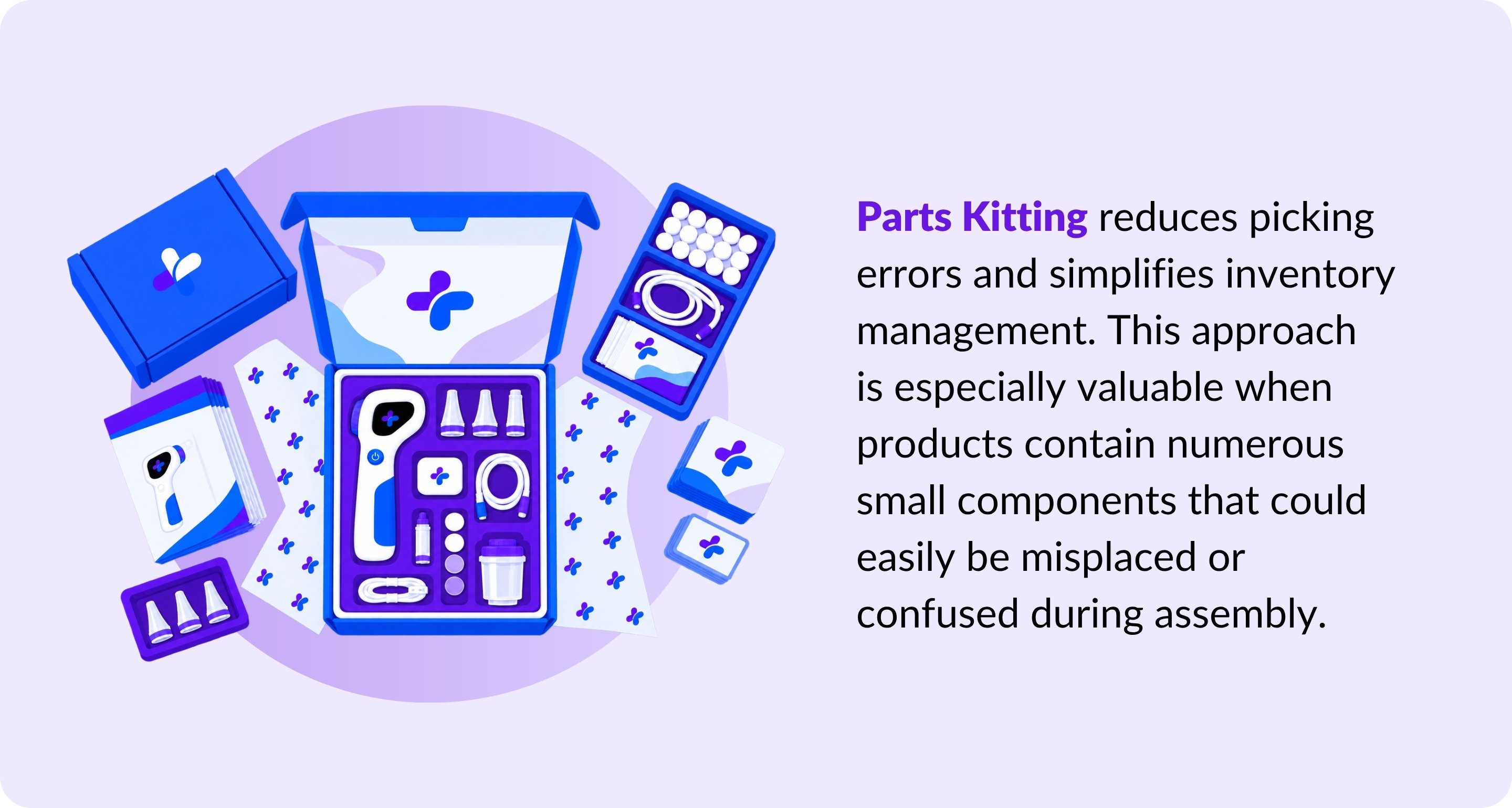
Parts kitting focuses specifically on gathering all components required to build a product or subassembly. Instead of stocking hundreds of individual components near every workstation, manufacturers create kits containing the exact combination of parts needed for a specific production run.
This approach reduces picking errors and simplifies inventory management. Parts kitting is especially valuable when products contain numerous small components that could easily be misplaced or confused during assembly.
Kitting vs. sub-assembly
Although frequently discussed together, kitting and sub-assembly are different activities. Kitting is the process of gathering materials and components into a ready-to-use kit. Sub-assembly occurs when some of those components are physically assembled into a partially completed unit before final assembly.
For example, a manufacturer might create a kit containing fasteners, wiring and brackets for a machine build. Those items may later be combined into a subassembly before being installed into the final product. In this way, kitting supports and enables efficient sub-assembly operations.
Product assembly
Product kitting ultimately supports the final assembly process by ensuring that production teams receive complete and accurate component sets. Instead of stopping work to find missing parts, assemblers can focus on building finished products according to established specifications.
This streamlined process helps improve production consistency while reducing non-value-added activities. In environments where every minute of uptime matters, providing fully prepared kits can significantly improve overall production effectiveness.
What are the benefits of kitting in manufacturing operations?
The most significant kitting benefits often stem from eliminating wasted motion and reducing production interruptions. When workers no longer need to retrieve parts from multiple locations, productivity improves and assembly operations become more predictable.
Improved inventory visibility is another major advantage. Because kits are built according to defined requirements, organizations gain greater insight into material consumption patterns and inventory levels. This supports more accurate planning and stronger inventory management services capabilities.
Kitting can also improve product quality. Pre-verifying materials before they reach the production floor helps reduce the likelihood of incorrect components being used in final assemblies. Better accuracy often translates to lower rework costs, fewer defects and improved customer satisfaction.
Organizations implementing inventory kitting frequently report better labor utilization as well. Employees spend less time searching, transporting and handling materials and more time performing productive manufacturing tasks. This can be especially valuable during labor shortages or periods of high production demand.
Finally, Lean manufacturing kitting supports continuous improvement initiatives by reducing waste associated with excess motion, waiting and unnecessary inventory. By delivering the right materials to the right location at the right time, manufacturers create more efficient production environments.

What are some real-world business examples of kitting in manufacturing?
The value of kitting in manufacturing becomes especially apparent in production environments where products contain numerous components, require frequent customization or involve strict quality requirements. Across many industries, organizations use material kitting, parts kitting and kitting and assembly strategies to reduce production delays, improve inventory control and create a more efficient manufacturing workflow. Explore the following examples and notice how different manufacturing sectors apply kitting techniques to support productivity and operational excellence.
Electronics manufacturing
Electronics manufacturing often involves thousands of individual components ranging from resistors and connectors to circuit boards and fasteners. Without organized kits, production personnel may spend considerable time locating and verifying parts before assembly can begin.
By implementing parts kitting and material kitting, electronics manufacturers can ensure that every workstation receives precisely the components required for each build. This reduces assembly delays, minimizes component shortages and helps maintain production schedules.
Medical device manufacturing
Medical device manufacturing requires strict attention to quality, traceability and regulatory compliance. Products frequently contain numerous components that must be assembled accurately and consistently.
A structured manufacturing kitting process can help ensure that all required parts, labels, packaging materials and instructions are available before production begins. This not only improves efficiency but also supports documentation and quality assurance efforts.
Industrial equipment manufacturing
Industrial equipment manufacturers often produce highly configurable products with varying specifications. As product complexity increases, so does the challenge of managing hundreds or thousands of parts across multiple product lines.
Kitting and assembly strategies help simplify these manufacturing environments by grouping the exact components needed for each configuration. As a result, manufacturers can reduce picking errors, support customization and maintain efficient workflows even when product variation is high.

What are the trade-offs of kitting in manufacturing?
While the kitting benefits can be substantial, manufacturers should recognize that kitting is not a one-size-fits-all solution. Like any operational strategy, the manufacturing kitting process introduces certain costs, resource requirements and planning considerations that must be balanced against the expected efficiency gains. Make sure you understand these trade-offs and then seek to determine whether inventory kitting, warehouse kitting or other types of kitting initiatives will deliver the greatest value to your business.
Efficiency vs. upfront labor
One of the most important trade-offs involves balancing efficiency gains against the labor required to build kits. Before production teams experience productivity improvements, someone must collect, verify and assemble the kits themselves.
However, many manufacturers find that relocating this work to dedicated kitting personnel creates greater overall efficiency. The labor invested upfront often results in significantly smoother production operations downstream.
Inventory accuracy vs. process complexity
Kitting can improve visibility into material usage, but it also introduces additional inventory transactions that must be tracked accurately. Components are moved from stock into kits, which creates another layer of inventory management activity.
Without strong systems and procedures, organizations may encounter discrepancies between component inventory and finished kits. Maintaining accurate records is essential to realizing the full value of inventory kitting programs.
Faster production vs. increased storage needs
Kits require space for assembly, staging and storage. Depending on production volume, manufacturers may need dedicated areas to support warehouse kitting operations before kits are delivered to production.
In many cases, the efficiency gains outweigh these space requirements. Nonetheless, organizations should evaluate available floor space and capacity before expanding kitting activities significantly.
When should manufacturers outsource kitting and fulfillment services?
While some organizations manage kitting internally, others benefit from partnering with providers that specialize in contract kitting services and warehouse kitting services. Outsourcing often makes sense when production volumes fluctuate significantly, product complexity increases, or internal labor resources become constrained.
Manufacturers may also consider outsourced kitting services when warehouse space becomes limited. A provider offering warehousing and fulfillment services can perform warehouse kitting, inventory storage and distribution activities off-site, freeing valuable production space for revenue-generating operations.
Organizations with growing distribution requirements frequently benefit from integrated fulfillment and kitting services as well. Combining order fulfillment services, assembly support and inventory management under one provider can simplify operations and improve scalability. Many providers also offer complementary distribution services, inventory management services and broader supply chain solutions that help streamline logistics from production through final delivery.
Partnering with a third-party logistics (3PL) provider may be particularly attractive when a business needs specialized labor, warehouse technology or geographic distribution capabilities that would be expensive to build internally. A qualified 3PL can provide value-added warehousing, fulfillment solutions and kitting and assembly expertise while allowing manufacturers to remain focused on core production activities.
Ultimately, the decision comes down to operational priorities. If internal resources can support efficient kitting at the required scale, in-house management may be appropriate. If growth, complexity or labor challenges begin creating bottlenecks, outsourced contract kitting services can provide the flexibility and expertise needed to maintain productivity and support long-term operational goals.
Taylor: Fulfillment and kitting services for manufacturers
Taylor provides warehousing and fulfillment services to manufacturers in a wide range of industries. We apply our vast network of warehousing and fulfillment centers — more than 1.7 million square feet across North America — to deliver contract kitting services that enhance assembly line efficiency, increase throughput, and reduce operating costs for manufacturing operations of all types. State-of-the-art order fulfillment services technology allows us to support rigorous just-in-time (JIT) fulfillment and Lean manufacturing kitting requirements as well.
Want to bring the many kitting benefits described in the blog above to your own manufacturing workflow? Contact Taylor to learn more about our fulfillment and kitting services for manufacturers.